

Hybrid mattresses make sense when you want a bed that feels more balanced than a basic foam or innerspring model. In Charlotte, Tony Discount is a furniture and mattress retailer that offers liquidation-priced home furnishings, so it is a useful local example when you look at whether a hybrid mattress can fit a tighter budget.
TL;DR: Summary
- A hybrid mattress is often a smart budget buy when you want foam-like pressure relief plus coil-based support, bounce, and airflow in one bed.
- Sleep Foundation describes hybrids as foam over an innerspring support core, often with pocketed coils that can improve motion isolation, edge support, and temperature regulation.
- The trade-off is price: hybrids usually cost more than basic all-foam or innerspring beds, though Charlotte retailers like Tony Discount can bring hybrid pricing down through liquidation inventory.
- If back comfort is a priority, a medium-firm feel is the safest starting point because PubMed-reviewed evidence links medium-firm mattresses with better comfort, spinal alignment, and lower back pain outcomes.
- Your best value comes from checking coil type, firmness, edge support, motion transfer, and total delivered cost, not just the sale tag.
If you are furnishing a home on a budget, the real question is not whether hybrid mattresses are good in general. It is whether the extra cost gives you better sleep, better support, and fewer compromises than a cheaper mattress type. In many cases, the answer is yes, especially if you shop carefully in Charlotte and focus on construction details instead of marketing labels.
What is a hybrid mattress?
A hybrid mattress combines a foam comfort system with an innerspring support core, usually pocketed coils. That mix gives you pressure relief from foam and support, bounce, and airflow from coils.
Sleep Foundation describes hybrids as a category built around two key layers: foam on top and coils underneath. That matters because each layer solves a different problem. Foam helps cushion pressure points at the shoulders and hips. Coils help keep the bed from feeling flat, overly soft, or trapped.
You will also see a few terms again and again when you shop. Motion isolation means how much movement stays on one side of the bed. Edge support means whether the sides compress too much when you sit or sleep near them. Temperature regulation usually improves when coils allow more airflow than a dense slab of foam.
A common misconception is that every hybrid feels the same. It does not. A thin foam layer over firm coils can feel much different from a thicker comfort system over zoned support coils.
How does a hybrid mattress compare with memory foam?
A hybrid mattress usually feels cooler, bouncier, and more supportive at the edges than memory foam. Memory foam usually absorbs more motion and can feel more contouring.
If you like a slow-moving, body-hugging feel, all-foam can still be the better fit. If you dislike the “stuck” feeling some foam beds create, hybrids often solve that problem because the coil core adds lift and responsiveness.
Price is the main trade-off. Sleep Foundation notes that hybrids generally cost more than all-foam mattresses because you are paying for both a comfort system and a coil unit. So if your budget is extremely tight, foam may win on upfront cost. If you want a more balanced feel that works for different sleep positions, hybrid often gives you more flexibility.
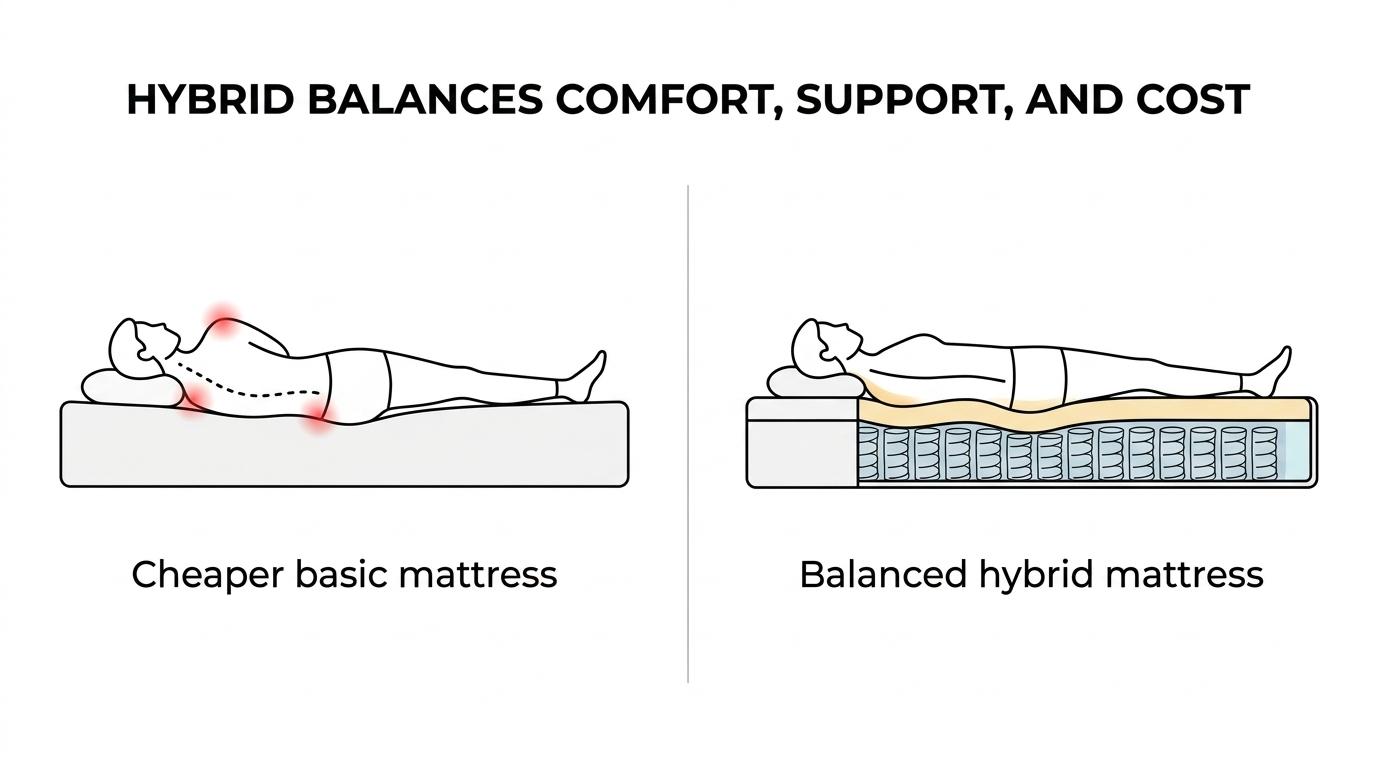
Here is the practical way to think about it. If you are a side sleeper who needs pressure relief first, memory foam may feel softer and more conforming. If you are a combination sleeper who changes positions, a hybrid can make movement easier at night.
What are the 7 best hybrid mattress benefits for budget shoppers?
The best hybrid mattress benefits are balanced support, pressure relief, cooler sleep, stronger edges, easier movement, partner-friendly motion control, and better long-term value when you buy at the right price.
Those benefits matter most when you are trying to avoid a costly mistake. A cheap mattress that feels wrong after two weeks is not really the cheapest option.
- Balanced feel: Foam cushions pressure points while coils help keep your spine from sagging.
- Better airflow: Coil cores usually breathe better than thick all-foam construction.
- More bounce: You can move and change positions with less effort.
- Stronger edges: Pocketed coil systems often feel sturdier near the sides than basic foam beds.
- Lower motion transfer than classic innersprings: Many hybrids reduce partner disturbance without losing all responsiveness.
- Wider comfort range: Medium-firm hybrids often suit back, side, and combination sleepers better than extreme soft or firm beds.
- Better value when discounted: Liquidation or closeout pricing can bring a premium-feeling category closer to entry-level budgets.
The key is that these benefits depend on the build, not just the word “hybrid” on a tag. A poorly built hybrid can still underperform, while a well-priced pocketed-coil model can feel like a major step up from a basic mattress.
How can you tell if a hybrid mattress is supportive enough?
A supportive hybrid keeps your spine neutral through the shoulders, waist, and hips, and medium-firm models are often the safest starting point. PubMed reviews connect medium-firm feel with comfort, sleep quality, and spinal alignment.
Start with your sleep position. If you mostly sleep on your back, you want your hips supported so they do not sink too far. If you mostly sleep on your side, you need enough cushion at the shoulder and hip without losing support under the waist. If you sleep on your stomach, too much softness can strain your lower back.
Next, check how the mattress feels after more than a quick sit test. Lie down long enough for your body to settle. If your hips dip, or if your shoulder feels jammed upward, the feel is probably wrong for you.
The biggest mistake here is assuming “firmer” always means “more supportive.” Support and firmness are related, but they are not identical. A bed can feel hard and still fail to keep your spine in a neutral position.
How do you shop hybrid mattress prices in Charlotte without overpaying?
In Charlotte, you save most on a hybrid mattress when you compare construction first and price second, and Tony Discount is one local example of a retailer using liquidation pricing on hybrid models.
Sleep Foundation’s mattress pricing guidance says hybrids usually cost more than basic foam or innerspring beds. That is normal for the category, so your goal is not finding the absolute cheapest hybrid. Your goal is finding one with the features that actually affect sleep quality.
Use this shortlist when you compare local options:
- Comfort layer: Check whether the top uses memory foam, polyfoam, or a thinner quilted layer.
- Coil system: Pocketed coils usually do more for motion isolation than older connected coil designs.
- Firmness target: Medium-firm is the most dependable starting point for mixed sleep needs.
- Edge performance: Stronger edges matter if you share a smaller bed or sit at the side often.
- Total cost: Include delivery, pickup logistics, foundation needs, and protector costs.
In Charlotte, liquidation pricing can change the math. Tony Discount lists multiple hybrid options, including a Premium Hybrid Mattress at $200 to $300, a Zoned-Support Hybrid Mattress at $300 to $350, and a Hybrid Pocketed-Coil Mattress at $450 to $500.

“Tony Discount lists hybrid mattress options from $200 to $500 in Charlotte, which matters in a category that usually costs more than basic foam or innerspring beds.”
Pro tip: do not judge a deal by percentage-off language alone. A “deep discount” on a weak coil system is still a poor buy if the mattress lacks support or wears out your comfort quickly.
Hybrid vs innerspring: which is the better budget buy?
A hybrid is usually the better budget buy for everyday comfort, while a basic innerspring is often the cheaper pick for a guest room or short-term setup. The right choice depends on how often you sleep on it and what annoys you most at night.
Traditional innersprings tend to be simpler and cheaper. They often feel bouncy and supportive enough at first, but they usually offer less pressure relief and more motion transfer than hybrids. If your partner tosses and turns, or if your shoulders and hips need cushioning, the upgrade to hybrid can feel meaningful.
If you only need a mattress for occasional use, an innerspring mattress may be enough. If the bed is for nightly use, especially in a primary bedroom, a hybrid often earns its higher price by reducing common comfort complaints.
A common misconception is that hybrid and innerspring are basically the same because both use coils. They are not. The foam comfort system is what gives hybrid its more balanced feel.
How do you choose the right firmness for back pain and spinal alignment?
Medium-firm is the best starting point for most adults, especially when back comfort is your main concern. PubMed evidence links medium-firm mattresses with better pain outcomes, comfort, and spinal alignment than overly hard surfaces.
Start with this simple rule: if your mattress lets your midsection sink too far, you may wake up stiff; if it feels too rigid at your shoulders and hips, you may toss and turn. Medium-firm often sits in the middle where both problems ease.
A 2017 PubMed systematic review concluded that a subjectively medium-firm mattress is optimal for sleep comfort, sleep quality, and spinal alignment. An earlier multicenter randomized trial also found that a medium-firm mattress improved pain and disability in people with chronic non-specific low-back pain.
If you are lighter in body weight and sleep on your side, you may prefer something a bit softer than medium-firm. If you are heavier or sleep on your stomach, you may need a slightly firmer feel. The key is not chasing a label. It is matching the mattress response to your body and sleep position.
What should you check before reserving or buying a hybrid mattress?
Before you reserve a hybrid mattress, confirm size, firmness, coil type, pickup or delivery details, and return expectations. Tony Discount’s online catalog and Charlotte pickup model make those checks easier before you bring a mattress home. That kind of detail matters for temperature too, and BFan notes in its breakdown of signs your mattress is making you sleep hot that dense materials and poor airflow are often part of the problem rather than the room alone.
This step matters more with hybrids because they are often heavier than basic foam models. Sleep Foundation notes that hybrids can be harder to move, so logistics are part of value, not an afterthought.
Check these details before you commit:
- Size: Make sure your bed frame, stair clearance, and room dimensions match the mattress.
- Height: Hybrids can sit taller than older innersprings, which affects sheets and bed appearance.
- Coils: Pocketed coils are usually the safer choice for motion control and balanced support.
- Trial mindset: Even without a long trial, spend real time testing pressure points and movement.
- Access plan: Confirm pickup timing or delivery access in Charlotte before checkout.
If you are comparing online listings, slow down and read the actual construction description. “Plush hybrid” tells you very little. “Foam comfort system with pocketed coils” tells you far more about how the bed may perform.
“Tony Discount offers online reservation with Charlotte in-store pickup and local delivery, a practical advantage because hybrid mattresses are usually heavier and harder to move.”
Pro tip: a mattress that feels great for 30 seconds can feel very different after 10 minutes. Stay on it long enough to notice pressure at your shoulders, lower back, and hips.
When is a hybrid mattress not the best budget choice?
A hybrid mattress is not the best budget choice when your lowest priority is comfort and your highest priority is price, weight, or maximum motion isolation. In those cases, basic foam or innerspring models may fit better.
If your budget ceiling is very strict, a simple all-foam or innerspring mattress will often cost less. If you need to carry the mattress upstairs by yourself, foam is usually easier to handle. If your partner is an extremely light sleeper, dense memory foam may absorb motion better than many hybrids.
You should also pass on a hybrid if the build details are vague. If a seller cannot tell you the coil type, firmness target, or comfort materials, you are guessing. Guessing is rarely a smart move when every dollar counts.
The better way to decide is simple. If you want a middle-ground mattress with pressure relief, support, bounce, and airflow, a hybrid is often worth the extra spend. If you need the cheapest possible bed or a very specialized feel, another category may serve you better.