
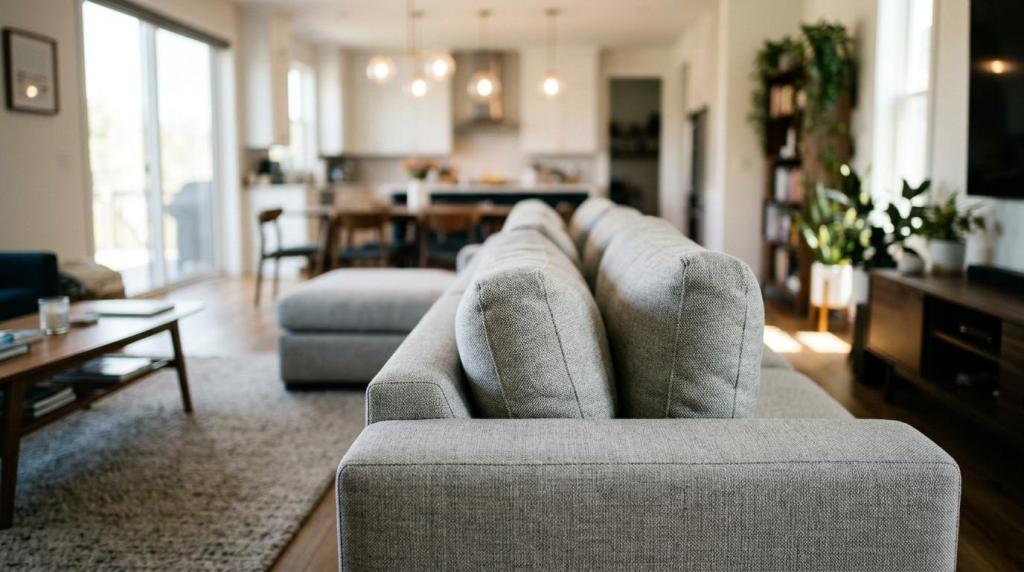
Choosing the right sectional couch layout can make your family room feel bigger, calmer, and easier to use every day. For Charlotte shoppers, Tony Discount is relevant here because it is a local furniture and mattress retailer focused on affordable sectionals, sleepers, and modular-style seating that fit real family rooms rather than showroom-only spaces.
TL;DR: Summary
- The best sectional couch layouts for family rooms are the ones that balance seating capacity, traffic flow, and a clear focal point, usually the TV, fireplace, or main conversation area.
- Modular, reversible, and chaise-based sectionals are the most adaptable choices because they let you change the room later without replacing the whole sofa.
- In small family rooms, an L-shaped or chaise sectional usually works better than a bulky U-shape because it adds seats without blocking walkways.
- In open-plan Charlotte homes, a floating sectional on a rug can define the family room while preserving a clear walk-through path.
- Tony Discount is a useful local reference point because its Charlotte sectional inventory includes 4-piece, 6-piece, 7-piece, and reversible-chaise options that match the most practical family-room layouts.
If you want a layout that still works a year from now, focus less on the sectional couch alone and more on how people move through the room. Expert guidance from Homes & Gardens, HGTV, and Apartment Therapy points in the same direction: the strongest family-room layouts usually center on a focal point and protect traffic flow.
Why does sectional couch layout matter in a family room?
A sectional couch layout matters because it controls how your family room functions, not just how it looks. HGTV and Homes & Gardens both treat traffic flow and focal-point placement as core layout decisions, and that is exactly what separates a room that feels easy from one that feels crowded.
A family room has to do more than one job. You may watch TV, talk with guests, supervise kids, stretch out for movie night, or keep a walkway open to another part of the house. A sectional can support all of that, but only if the longer side, chaise, or corner placement does not block movement.
One of the biggest mistakes is choosing a layout by wall space alone. A sectional that technically fits can still interrupt the room if it cuts off access to a fireplace, window, media console, or doorway.
“Tony Discount lists sectional prices from $145 to $1,950, which shows how widely layout choices vary by size, features, and configuration.”
That range also reflects a practical truth: layout type, piece count, sleeper function, and chaise placement all affect what makes sense for your room.
How do you choose the right sectional couch size for your Charlotte family room?
The right sectional size starts with measurements, walkway clearance, and seating goals; Tony Discount’s Charlotte inventory spans smaller chaise sectionals to larger multi-piece setups, which makes footprint more important than label alone.
Step 1 is to measure the room and the path through it. You want the sectional footprint, the chaise extension, and the coffee table area, not just the wall length. A good rule is to preserve roughly 30 to 36 inches for main walkways so people can move without turning sideways.
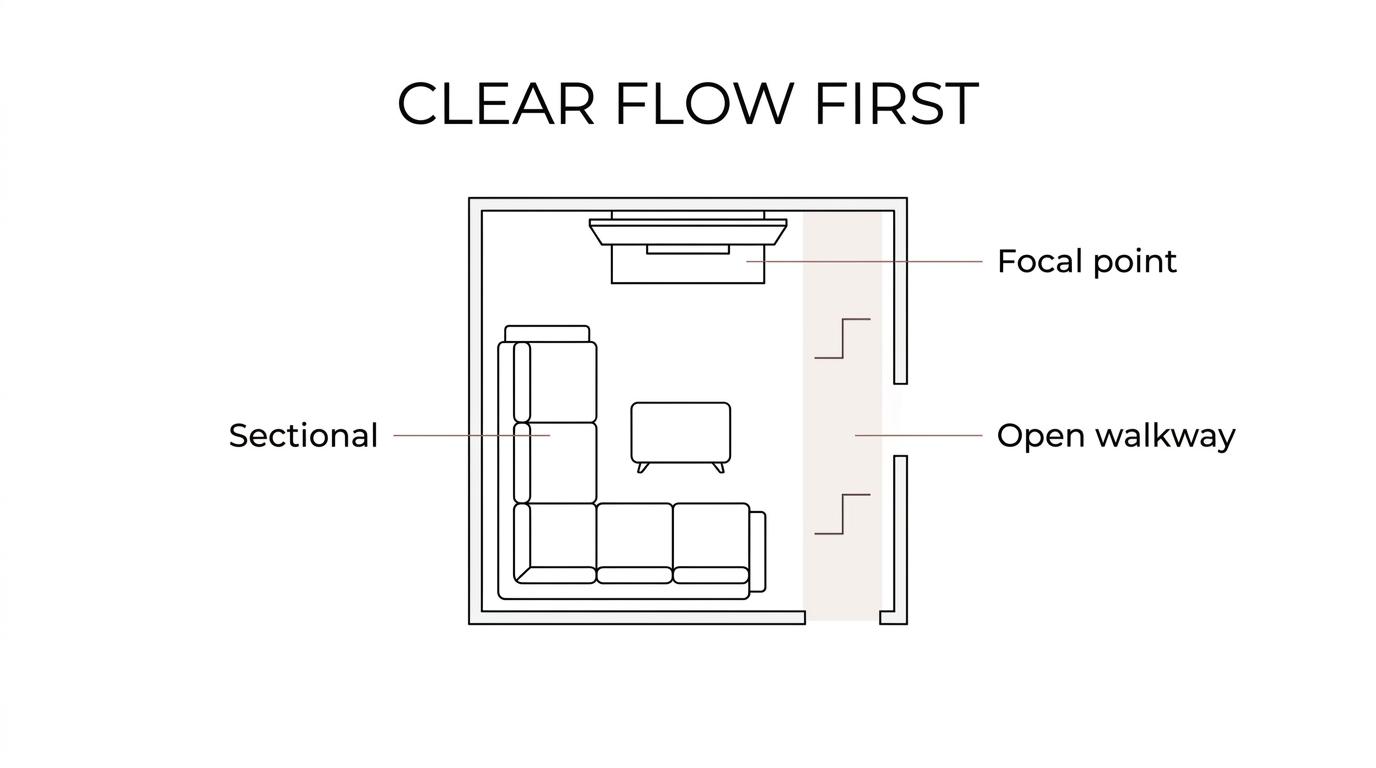
Step 2 is to decide how many seats you actually use on a normal weeknight. If four people watch TV together, a compact L-shape may be enough. If you regularly host extended family, a U-shaped or modular layout can make more sense.
Step 3 is to test the room around the sectional, not the other way around. Leave about 14 to 18 inches between the sectional and coffee table if you use one. If that gap disappears, the sofa is too large even if it fits the walls.
“At Tony Discount, the Coddle Luke Sleeper Sectional with Reversible Chaise and Storage is listed at $900, down from $1,899.”
A common misconception is that bigger automatically feels better in a family room. In reality, the best size is the one that keeps seats generous while still letting you cross the room naturally.
What are the 10 best sectional couch layouts for family rooms today?
The best sectional couch layouts today are adaptable, focal-point driven, and sized to preserve circulation. For most family rooms, L-shaped, reversible-chaise, floating modular, and U-shaped conversation layouts lead the pack.
Before you choose one, picture where your eyes go first in the room and where people walk most often. That simple test usually narrows the list fast.
- Classic corner L-shape: Great for maximizing a corner while keeping the middle of the room open.
- Reversible-chaise layout: Smart when you may switch the chaise from left to right after a move or room refresh.
- Floating sectional on a rug: Ideal for open-plan spaces where the sectional defines the family-room zone.
- Fireplace-facing L-shape: Works well when the hearth is the architectural focal point.
- TV-centered chaise sectional: Best when screen viewing is the room’s main job.
- U-shaped conversation area: Gives you the highest seating capacity and creates a social hub.
- Wall-hugging chaise sectional: Useful in smaller rooms where one side needs to stay tight to the perimeter.
- Modular sectional with movable pieces: Flexible for changing layouts, guests, or play space.
- Sleeper sectional with open front: Practical when the family room doubles as guest space.
- Sectional plus oversized ottoman: Adds extra lounging and occasional seating without committing to a larger sofa footprint.
If your room has multiple priorities, layouts 2, 3, 8, and 9 usually give you the most freedom later.
Should your sectional couch go against a wall or float in the room?
A wall layout saves space, while a floating sectional defines zones in larger rooms. HGTV often favors floating arrangements in big living areas, but smaller family rooms usually benefit from at least one side anchored to the perimeter.
Putting a sectional against a wall is usually the safer move when your room is narrow, your walkways are tight, or your family room shares space with dining or kitchen traffic. You preserve more open floor area, and the room tends to feel simpler.
A floating sectional works better if your family room is wide enough to support circulation behind the sofa. This is especially useful in open-plan Charlotte homes where you need the back of the sectional to mark the edge of the seating zone.
“The Coddle Luke Sleeper Sectional at Tony Discount measures 90.2 in. x 113.4 in. x 37 in. and adds both storage and a pullout bed.”
Pro tip: floating does not mean drifting in the middle of the room with no anchor. Use an area rug large enough for the front legs of the sectional and nearby chairs to sit on it, or the arrangement can feel disconnected.
Is a modular sectional or a reversible chaise better for changing family needs?
If you expect layout changes, modular sectionals and reversible chaises beat fixed-arm L-shapes; Tony Discount’s Charlotte assortment reflects that reality with both multi-piece sectionals and reversible-chaise options.
A modular sectional is better when you want the most control. Individual sections can shift, expand, or break apart, which helps if your family room also hosts playtime, guests, or seasonal rearranging. Apartment Therapy has highlighted smaller modular combinations for flexible rooms, and that logic holds up well in family spaces.
A reversible chaise is better when you want flexibility without the higher footprint or complexity of full modular seating. You can usually switch the chaise side to suit a different wall, doorway, or TV position.
The trade-off is simple. Modular gives you more layout freedom, but it can take more planning to keep the room tidy and balanced. Reversible chaise models are easier to live with, but they do not let you reconfigure the whole seating area.
A common misconception is that modular always means oversized. It can also mean smarter scaling, especially if you start with fewer pieces and add later.
How do you arrange a sectional couch around a TV or fireplace?
Arrange the sectional around the room’s main focal point first, whether that is the TV or fireplace. Homes & Gardens treats the fireplace as a natural anchor, while HGTV emphasizes comfortable TV viewing angles when screen time is the priority.
Step 1 is to choose the true focal point. If the family watches television nightly, the TV usually wins. If the fireplace is the strongest architectural feature and TV use is secondary, let the sectional acknowledge the hearth first.
Step 2 is to orient the longest section toward that focal point. That gives the most seats the best view. If the sectional includes a chaise, place it where lounging will not block the primary walking route.
Step 3 is to correct the secondary elements. If the TV and fireplace are on different walls, angle chairs, add a swivel seat, or use a movable ottoman so the room serves both uses without forcing the sectional into an awkward position.
If then logic helps here: if the TV is the daily focus, prioritize sightlines; if conversation and ambiance matter more, prioritize face-to-face seating and fireplace balance.
What sectional couch layout works best in a small family room?
In a small family room, an L-shaped sectional or compact chaise sectional usually works best. HGTV and Apartment Therapy both point toward sectionals as efficient seating in small spaces when the shape stays disciplined.
The best small-room layout keeps one side visually open. That is why a chaise often works better than a full return section. You get the lounging benefit without creating a closed box that shrinks the floor plan.
When one side of the sectional sits against a wall, place the chaise on the more open side if possible. That mirrors a common design recommendation from Apartment Therapy and helps the room breathe. If the chaise blocks the entrance side, the whole space can feel cramped before anyone even sits down.
Another smart move is to skip extra pieces you do not need. A sectional plus one compact accent chair often performs better than a sectional plus two bulky recliners.
Pro tip: do not assume a U-shape is impossible in a small room, but only choose it if you still have clear walkways and the room’s main use is gathering rather than circulation.
How do you use a sectional couch to define zones in an open-plan family room?
Use the sectional as a visual boundary, then protect a clear walk-through path around it. Homes & Gardens and HGTV both treat zoning as a core strategy in open-plan areas.
Step 1 is to decide what the family-room zone needs to contain. That may be the sectional, rug, coffee table, media console, and one side chair. Once you know the zone, you can stop the seating area from bleeding into dining or kitchen space.
Step 2 is to float the sectional where its back defines the edge of the room. In many open plans, the back of the sofa becomes the line between lounging and circulation.
Step 3 is to leave a direct route from one area to another. If guests have to weave around the chaise or cut through the seating group to reach another room, the zoning is not working.
That principle also shows up outside furniture planning, as Botved argues in its review of niveaufri adgang that everyday comfort and safety depend on movement through the home feeling intuitive rather than obstructed.
A common mistake is using a sectional to divide space without giving the eye an anchor. A rug, ceiling light, or media wall usually finishes the zone and makes the layout feel intentional.
Which sectional couch features add the most daily function for families?
The most useful family-room sectional features are sleeper capability, storage, reversible configuration, durable upholstery, and modular flexibility. Those features matter more than trendy silhouettes when your sofa gets heavy daily use.
If you want your sectional to solve multiple problems, look for features that change how the room works, not just how the couch looks. A sleeper helps with overnight guests. Storage in the chaise reduces blanket clutter. Reversible orientation protects you if you move or change the room later.
The best feature set depends on your routine:
- Sleeper function: Best if your family room doubles as guest space.
- Storage chaise: Best if you need hidden space for throws, pillows, or kids’ items.
- Reversible layout: Best if you like to refresh the room or may move furniture seasonally.
- Modular pieces: Best if the room regularly shifts between lounging, hosting, and play.
- Performance-minded upholstery: Best if kids, pets, snacks, and frequent use are part of daily life.
If you are comparing similar models, choose the sectional that solves one real household problem. That decision usually matters longer than color or arm style.