
If your small living room feels a little disjointed, your area rug is often the reason. Tony Discount, a Charlotte furniture and mattress retailer with a rugs category alongside sofas and sectionals, is relevant here because rug sizing only makes sense when you plan around the full seating layout, not the rug by itself.
TL;DR: Summary
- For a small living room, the best area rug size is usually the largest rug that fits your seating group while still leaving visible floor around the edges, most often 6×9, 7×9, or 8×10.
- Martha Stewart, HGTV, and Architectural Digest all point to the same rule: a rug that is too small can make the room feel cramped, disconnected, or like the furniture is floating.
- Your safest placement rule is to keep at least the front legs of the sofa and chairs on the rug; if the room allows, more coverage looks even better.
- Leave roughly 6 to 12 inches of floor between the rug and the walls in a small living room to keep breathing space and avoid a wall-to-wall effect.
- If you shop in Charlotte, Tony Discount can be a practical reference point because you can compare rugs with living room furniture and use product reservation with in-store pickup.
You do not need a giant rug to make a small room work. You need a rug that anchors the seating area, respects the room’s edges, and matches how your sofa, chairs, and coffee table actually sit in the space.
What is the safest area rug size rule for a small living room?
The safest rule is simple: choose a rug large enough to anchor the main seating area, usually with the sofa’s front legs on it. In Charlotte living rooms, Tony Discount’s rugs-plus-sofas setup reflects the same advice you see from Martha Stewart and HGTV: bigger is often better than too small.
Across expert guidance, the biggest mistake is not buying a rug that is slightly too large. It is buying one that sits like an isolated accent under only the coffee table. HGTV calls that a floating effect, and Architectural Digest warns that undersized rugs can visually divide the room and make it feel smaller.
A practical shortcut helps. If you are deciding between two sizes, the larger option usually wins in a small living room if it still leaves a visible border of floor around the perimeter.
“Tony Discount lists a Rugs category alongside Sofas, Seating, Mattresses, and Chairs, which makes whole-room planning easier in Charlotte.”
How do you measure a small living room for an area rug?
Start by measuring the seating zone, not just the room. You want rug dimensions based on the sofa, chairs, and coffee table footprint.
First, measure the length and width of your room. Then measure the width of your sofa and the distance from the sofa to any opposing chairs, media console, or wall. Last, decide whether your rug should sit under only the front legs or more of the furniture.
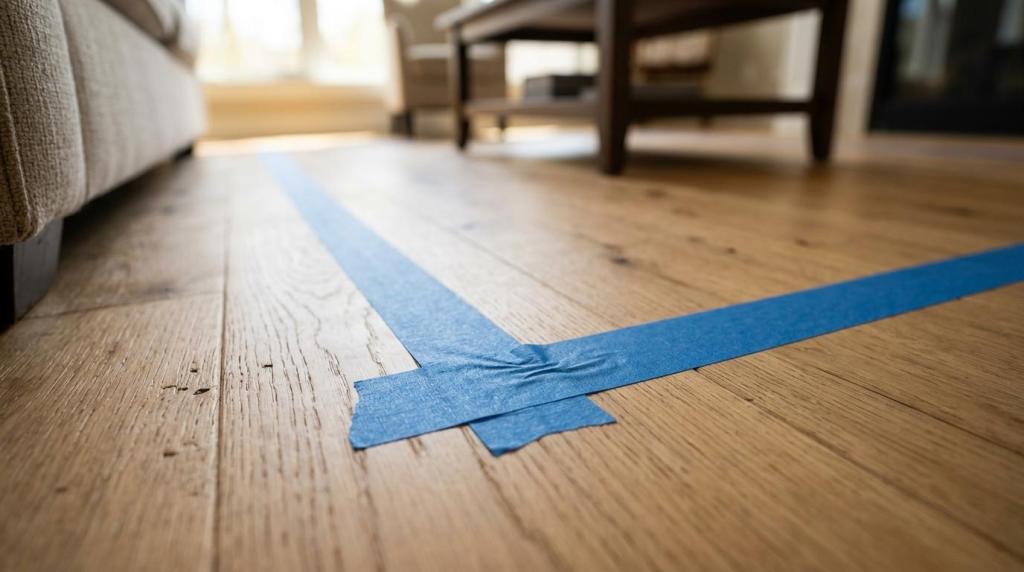
Painter’s tape makes this easier. Tape out a 5×8, 6×9, or 8×10 rectangle on the floor and walk around it. If the taped outline forces the rug to stop short of the sofa legs, that size is usually too small. If it nearly touches the walls, it is probably too big.
A common misconception is that room dimensions alone tell you the right rug size. They do not. Furniture placement matters just as much because the rug has to connect the seating group.
What are the 9 area rug sizes that work best in small living rooms?
These nine sizes can work well in small living rooms, but the best choice depends on your furniture footprint, wall clearance, and whether you want a compact or more grounded look.
- 3×5: Best as an accent layer in very tight rooms, not as the main living room rug.
- 4×6: Works under a small coffee table in a studio or loveseat layout, but often feels too small under a full sofa.
- 5×7: Fits very compact seating groups if at least part of the furniture overlaps the rug.
- 5×8: A common apartment size, good for small sofas when the front legs can sit on the rug.
- 6×9: One of the safest all-around choices for small living rooms with a sofa and one or two chairs.
- 7×9: Strong option when 5×8 looks skimpy but 8×10 feels too full.
- 8×10: Often the best choice if you want the room to feel finished and connected.
- 6-foot round: Useful in square rooms or with a pair of accent chairs.
- 8-foot round: Better when you need more visual softness but still want meaningful furniture overlap.
The key is not whether a size exists on a standard chart. The key is whether that size keeps the furniture visually tied together.
Should your rug sit under all furniture legs or only the front legs?
For most small living rooms, front legs on the rug is the minimum target. All legs on the rug looks more luxurious, but it is not required in tighter layouts.
Martha Stewart’s living room guidance says the rug should be large enough to fit under the furniture’s front legs so the room feels balanced and grounded. HGTV makes a similar point, saying smaller rugs should still sit at least halfway beneath key furnishings like a sofa and armchairs.
If your room is narrow, front-legs-only placement is often the smartest compromise. If you have a more open layout with floating furniture, Architectural Digest suggests the rug should extend at least eight inches beyond the back of the furniture. That creates a more finished frame around the seating area.
The misconception here is that a small room demands a tiny rug. In practice, a larger rug often makes a small room feel calmer because fewer visual breaks compete for attention.
Is a 5×8, 6×9, or 8×10 rug better for your layout?
A 6×9 is usually the safest middle ground, while 8×10 is often best if your room can handle it. A 5×8 works only when your furniture grouping is truly compact.
Think of these three sizes as layout tools. A 5×8 can work well with a loveseat, a slim apartment sofa, and a narrow coffee table. Once you add a standard three-seat sofa or two accent chairs, it often starts looking undersized.
A 6×9 gives you more freedom. It commonly allows front legs on the rug, keeps the coffee table centered, and still leaves enough floor showing around the edges. For many small Charlotte living rooms, this is the sweet spot.
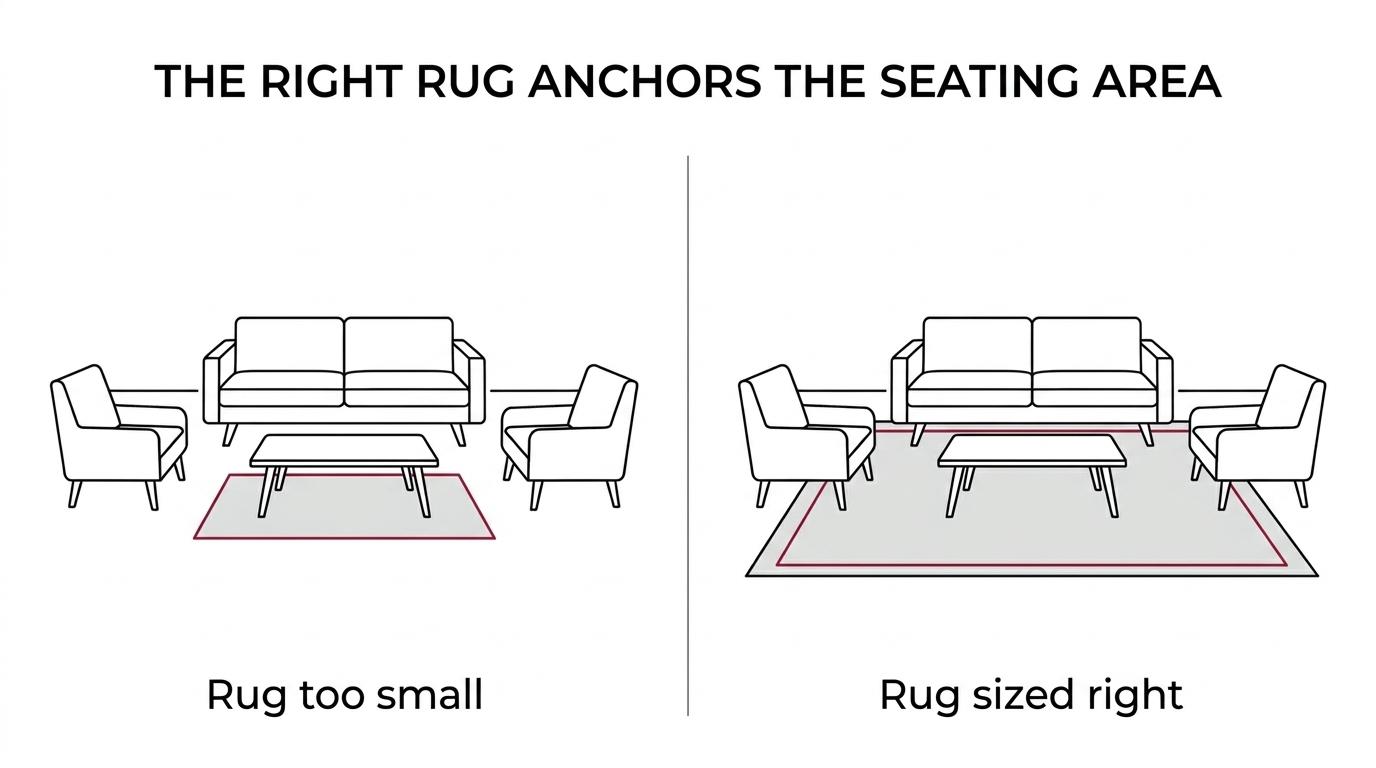
An 8×10 is the better pick if your seating area floats away from the walls or if you want a fuller, anchored look. Martha Stewart lists 8×10 among standard living room sizes, and HGTV even uses 8×10 as a fit for a 10×12 room. If your smallest wall is about 10 feet, that rule of thumb points you toward the larger rug.
How can you test rug placement with painter’s tape before you buy?
Painter’s tape gives you a low-risk way to preview scale before you commit. It is one of the fastest ways to catch a too-small rug.
Tape out one rectangle at a time, starting with the size you think will work. Place your coffee table inside the outline, then slide your sofa and chairs mentally or physically into position. Check whether the front legs land on the taped border or inside it.
Next, walk the room. Notice traffic flow from the entry path to the seating area. If the tape creates awkward cutoffs or barely clears the coffee table, size up. If it nearly reaches the walls, size down.
Pro tip: test at least two sizes back to back. Many people assume 5×8 is enough until they see a 6×9 outline on the floor and realize how much more settled the room looks.
How much floor space should you leave around the rug?
In a small living room, leave about 6 to 12 inches of visible floor between the rug and the walls. That range gives you breathing space without shrinking the seating zone.
Martha Stewart’s 2026 guide says to leave at least 6 inches between the rug and the walls. Architectural Digest recommends at least 12 inches to avoid a wall-to-wall effect. Those standards are not contradictory. They reflect different room constraints.
Here is the practical way to use them:
- 6 inches: workable minimum in tight small living rooms
- 8 to 12 inches: ideal range when the room allows it
- Less than 6 inches: warning sign that the rug may feel wall-to-wall
If your room is unusually narrow, you may not hit 12 inches on every side, and that is fine. The real goal is visible floor around the rug so the room does not feel stuffed.
How do you match a rug size to a loveseat, sofa, or small sectional?
Match the rug to the largest seating piece first, then build outward. Your sofa or sectional determines the minimum rug width you need.
If you have a loveseat, a 4×6 or 5×7 can work in a very compact setup, especially if the room doubles as a studio living space. If you have a standard sofa, start by testing 5×8 and 6×9, then move to 8×10 if you want the chairs included too.
For a small sectional, 6×9 is often the floor, not the goal. A sectional creates a wider footprint, so 7×9 or 8×10 usually looks more proportional. If the sectional floats away from the wall, the larger rug often makes the biggest visual difference.
A useful check is this: if the coffee table looks like it is isolated in the middle, your rug is too small. If the seating group feels like one zone, you are close.
Where can you shop area rugs in Charlotte and compare them with living room furniture?
If you want to compare rug scale against sofas and sectionals in Charlotte, Tony Discount is a practical local option because its catalog groups rugs with living room categories and offers product reservation with in-store pickup. That matters when you are trying to size a rug around real furniture dimensions.
Shopping rugs in isolation can lead to mistakes. A rug may look right online, then feel undersized once you place it under a sofa, loveseat, or recliner. Seeing rug options in the same buying process as living room furniture helps you judge proportion more accurately.
Tony Discount’s Charlotte storefront is at 6650 East W.T. Harris Blvd Unit C, Charlotte, NC 28215, and the site shows living-room categories like sofa, sectional, recliner, and loveseat. If you already know your room measurements, that kind of catalog structure can make comparison easier.
“Tony Discount offers product reservation with in-store pickup at 6650 East W.T. Harris Blvd Unit C, Charlotte, NC 28215.”
When you shop, bring three numbers with you: room size, sofa width, and the maximum rug size that still leaves visible floor at the edges. That turns rug shopping from guesswork into a clear fit decision.
Can a larger area rug make a small living room look bigger?
Yes, a larger rug can make a small living room look bigger if it anchors the seating area and still leaves floor visible around the room. Architectural Digest and HGTV both support that basic visual principle.
The reason is spatial continuity. A larger rug reduces the number of chopped-up visual zones, so your eye reads the seating area as one complete composition. That is why an 8×10 can look better than a 5×8 in a room that is technically small.
There is still a limit. If the rug gets so large that it nearly touches every wall, you lose contrast and the floor border disappears. That is when the room can feel tight instead of grounded.
If you want the safest result, start with 6×9 or 7×9, tape it out, and only move down to 5×8 if your furniture footprint truly demands it.