
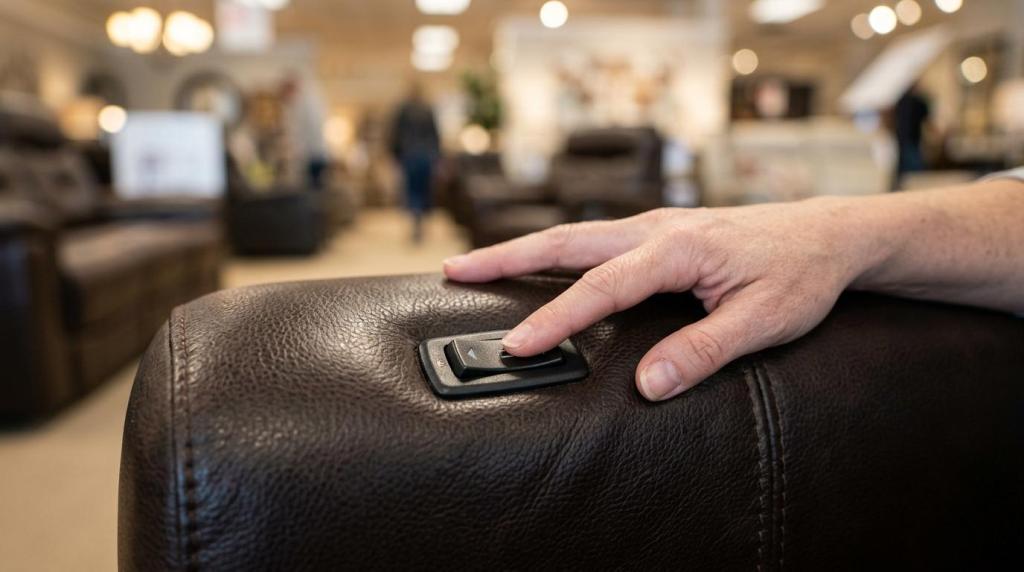
Choosing between a manual and power recliner comes down to how you want the chair to work for your body, your room, and your budget. In Charlotte, shoppers comparing local options from Tony Discount can quickly see the split: manual recliners keep things simple, while power recliners often add motorized support features that change day-to-day comfort.
TL;DR: Summary
- A power recliner is usually the better choice when ease of use, adjustable support, or limited mobility matters most, while a manual recliner is often better when you want lower cost, no outlet requirement, and fewer electrical parts.
- The biggest manual vs power recliner differences are how they recline, how easy they are to operate, what support features they add, how hard they are to stand up from, and what setup or maintenance they require.
- PubMed research on chair design shows that lower seat height, more seat tilt, deeper recline, and softer seat compression can make standing harder, especially for older adults.
- Tony Discount’s Charlotte catalog reflects a common market pattern: power recliners may add power headrests, power lumbar, and USB-A/USB-C charging, while manual models stay mechanically simpler.
- If you value reading, TV viewing, napping, or aging in place, power often gives you better position control. If you value easy placement and lower upfront risk, manual still makes strong sense.
The best choice is not about which type is “better” in the abstract. It is about which trade-offs matter most in your home, especially if you care about standing ease, outlet access, repair exposure, or long sitting sessions.
Which recliner is easier to use every day?
Power recliners are easier for most people to use every day, while manual recliners are simpler to own. If grip strength, balance, or joint pain matters, push-button controls usually beat a side lever or a push-back motion.
That ease matters most during transitions, not just while lounging. A manual recliner may feel fine once you are settled, but getting the footrest up and the backrest where you want it can take force through your arms, hips, or legs. With power, you press and stop where you want.
If more than one person uses the chair, power also makes it easier to fine-tune the position. That is especially helpful if one person likes a slight leg raise and another prefers a deeper recline. A common mistake is treating all recliners as if they only have two positions. In real use, the number of comfortable stop points changes the experience.
How do manual and power recliners actually recline differently?
Manual recliners use body weight, a side lever, or a handle. Power recliners use an electric motor and switch to move the back and footrest more gradually and with more stop points.
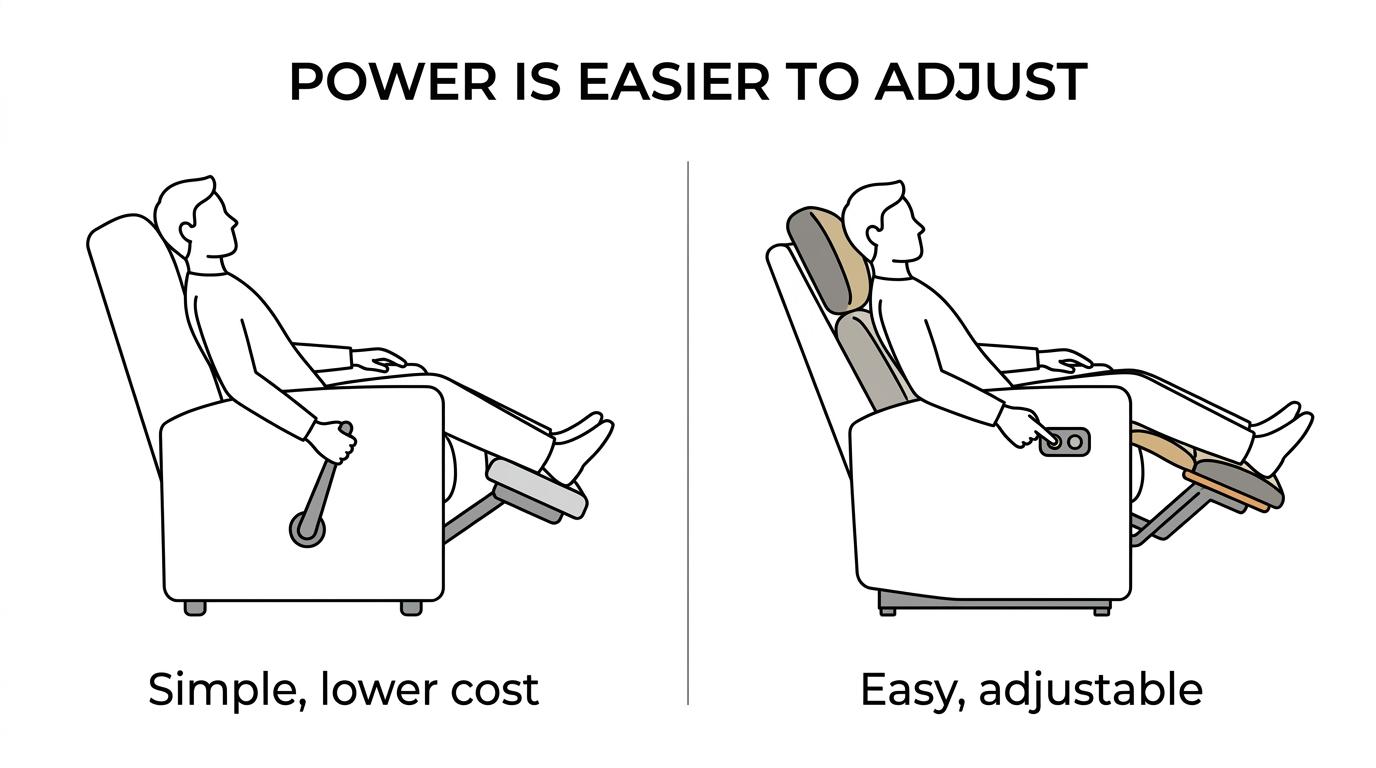
With a manual chair, you typically trigger the footrest and then lean back to continue reclining. That means the motion depends on your body mechanics. Some people like that direct feel. Others find it abrupt or harder to control, especially if they want only a slight recline.
Power models usually move in smaller increments, which helps you dial in a reading angle, TV angle, or nap angle instead of settling for “close enough.” Many shoppers think reclining is just footrest up or down, but precision is one of the biggest real-world differences.
“Tony Discount’s Charlotte catalog shows the pattern clearly: power reclining pieces can add power headrests, USB-A and USB-C charging, and Leggett & Platt CLOUDZERO mechanisms.”
What are the 7 manual vs power recliner differences that matter?
Seven differences usually decide the purchase: operation, support features, standing effort, setup, safety and repair exposure, price, and room fit. If you compare those seven, you can choose faster and with fewer regrets.
When you shop, upholstery and color often grab your attention first. They should not be your first filter. Start with function, because a beautiful recliner that is hard to use will not stay comfortable for long.
- Operation: Manual recliners use a lever, handle, or push-back action; power recliners use motorized controls.
- Position control: Manual models often have fewer practical stop points; power models usually allow finer adjustment.
- Support features: Power recliners may add power headrests, power lumbar, lift assist, or USB charging; manual chairs usually do not.
- Standing difficulty: Seat height, seat compressibility, and recline geometry can make rising easier or harder regardless of style, but power helps you return to upright with less effort.
- Setup needs: Manual chairs can go almost anywhere; power recliners need outlet access and better cable planning.
- Repair risk: Manual mechanisms are mechanically simpler; power adds motors, switches, transformers, and cords.
- Price and value: Manual usually costs less upfront; power may justify the extra spend if you use it daily or need the support features.
How should you test seat height and standing ease in a Charlotte showroom?
Chair geometry matters more than most shoppers expect. PubMed research found lower seat height, posterior seat tilt, greater backrest recline, and higher seat compressibility made standing harder for older adults.
Step 1: Sit all the way back and check your knee and hip position. If your knees sit noticeably higher than your hips, or if the seat sinks too deeply under you, standing will usually take more effort.
Step 2: Lean back and return to upright three times. Do not just test the “comfortable” feeling at rest. Test the full motion of sitting down, reclining, and standing up, because that is where bad fit shows up.
Step 3: Stand without using a dramatic rocking motion if you can. If you must scoot forward, brace hard on the arms, or push several times to rise, the chair may be too low, too soft, or too tilted for you.
The plushest chair is not always the most usable chair. If the cushion compresses too much, your body has farther to travel upward, and the research on older adults shows that can increase rise difficulty. If you are shopping for a parent or grandparent, this detail deserves more attention than fabric.
How do power headrests, lumbar support, and USB ports change comfort?
Power recliners at Tony Discount illustrate the main upgrade: motorized chairs can add power headrests, power lumbar, and USB charging that manual recliners usually do not offer.
These features matter because comfort is not just about reclining farther. A power headrest can support your neck while you read or watch TV without forcing you into a flat, nap-like angle. Power lumbar can help fill the gap at your lower back when the seat is otherwise comfortable but not quite supportive.
A local product example shows how wide the feature gap can be. One listed power reclining sofa includes 2 power recliners, 2 power headrests, a Leggett & Platt CLOUDZERO mechanism, and USB-A/USB-C ports. Another listed sectional includes 3 power recliners, a power headrest, and 2 USB ports. Those upgrades change how the seat works, not just how it looks.
“One Tony Discount listing shows how wide the feature gap can be: 2 power recliners, 2 power headrests, USB-A and USB-C ports, and a $700 price on a sofa previously listed at $1,279.99.”
If you mainly want a chair for short sitting sessions, those extras may not matter much. If you read, stream shows, nap, or work from a tablet in that chair every day, they can matter a lot.
Which recliner is better for older adults or limited mobility?
Power recliners are usually the better fit for older adults, arthritis, or reduced leg strength, but only if the chair’s height and firmness still support standing. A power button helps, yet poor geometry can still make a chair hard to exit.
This is where the research becomes practical. A PubMed study on chair rise found that lower seat height, posterior seat tilt, greater backrest recline, and seat compressibility all increased rise difficulty in older adults. In the hardest chair conditions, some older adults could not stand up independently.
Another PubMed study found that an assistive handle helped 8 of 26 otherwise dependent rehabilitation patients stand independently from an armless chair, but knee extension force still predicted who could do it. That means support features help, but leg strength still matters. If you need true standing assistance, do not assume every power recliner is a lift chair. That is a common mix-up.
There is also a comfort angle. In a randomized trial involving older emergency-department patients, reclining chairs produced a 97% versus 76% success rate on the study’s pain outcome and higher satisfaction scores of 8.1 versus 6.0 compared with remaining on a gurney. That does not prove every living-room recliner is therapeutic, but it does support the idea that reclining seating can materially improve comfort when sitting for extended periods.
How do setup, outlet access, and room placement differ?
Manual recliners win on setup because they do not need an outlet. Power recliners need cable routing, outlet access, and more planning around furniture layout and moving paths.
If your ideal spot is in the middle of a room or far from a wall outlet, manual is easier. With power, you need to think about where the cord will run, whether it could be pinched, and how close the chair can sit to the wall at full recline. Some models are more space-efficient than others, so you should always measure the exact piece rather than guessing by category.
A frequent mistake is measuring only the width. Recliners also need front clearance, rear clearance, and usable side access so you can get in and out comfortably. If the room is tight, the more “convenient” chair on paper can become the more frustrating chair in practice.
How can you compare reliability and safety before you buy?
Use the same safety process for any retailer, including Tony Discount: check CPSC recalls, inspect the switch and cord, and test every motion before you commit to a power recliner.
Step 1: Look up the exact model or collection name on the CPSC site if you are considering a power piece. That is worth doing because electrical components can fail in ways manual chairs simply do not.
Step 2: Inspect the control, cord path, and movement. If a switch feels loose, motion hesitates, or the mechanism sounds strained, stop and ask questions before buying.
Step 3: Test upright return and full recline several times. You want smooth travel, predictable stopping, and no heat, odor, or unusual resistance.
That caution is grounded in real cases. In 2026, the CPSC reported a recall affecting about 8,200 power recliners and related living-room pieces after a power switch malfunction could overheat. The report referenced 41 incidents, including smoking, burning, and electrical odor, with two fires. That does not mean power recliners are a bad choice. It means you should inspect them like powered products, not like simple static seating.
How should you compare cost versus long-term value?
Manual recliners usually cost less upfront, but power recliners can deliver better long-term value when comfort, daily use, or mobility support matter enough to change how often you actually use the chair.
Start with the cost you can see, then add the value you will feel. A lower sticker price is great, but it is not the whole calculation if the chair is harder to use every day.
Step 1: Compare upfront price against feature gap. If the power model adds headrest adjustment, lumbar support, and easier operation, ask whether those features solve a real problem for you.
Step 2: Weigh repair exposure against use frequency. If you want fewer moving parts and simple ownership, manual has the edge. If you will spend hours in the chair every day, the powered adjustments may be worth the extra complexity.
Step 3: Think in years, not weekends. If a power chair helps you read longer, stand easier, or avoid buying extra support accessories, the value picture can change.
You can keep the comparison practical with a short checklist:
- Upfront price: Manual is usually lower.
- Daily comfort: Power often wins.
- Repair exposure: Manual is simpler.
- Mobility support: Power usually wins.
- Outlet requirement: Manual is easier.
What size and room-fit mistakes should you avoid?
The biggest mistake is buying by photo alone. Recliners need enough width, depth, and full-recline clearance, and your body needs support at the knees, shoulders, and head in the positions you will actually use.
A chair can look proportional online and still feel wrong in person. If the headrest hits below your shoulders, the seat edge presses into the back of your knees, or the arms are too low to help you stand, comfort drops fast. This is why body fit matters as much as room fit.
Use a simple final check before you decide:
- Measure fully reclined depth
- Check doorway and stair clearance
- Test head support at reading angle
- Test arm support while standing up
- Confirm footrest comfort at full extension
If you do that, you will make a better call between manual and power than most shoppers who focus only on fabric, color, or a sale tag.