
Choosing between a plush bed and a firm mattress can feel simple until you actually lie down on a few. What sounds supportive in a product description may feel stiff in person. What sounds soft and inviting may leave you shifting all night.
Your best choice usually is not the softest mattress in the showroom or the hardest one marketed as “extra support.” It is the one that keeps your body supported without creating pressure points, especially at your shoulders, hips, and lower back.
If you are shopping in Charlotte, that balance matters even more when you want strong value. You want a mattress that feels good tonight, still feels right months from now, and fits your budget without making you settle for poor sleep.
Why mattress firmness matters more than marketing labels
Mattress labels can be misleading. One brand’s “firm” may feel like another brand’s medium-firm. A “plush” model might still have strong coil support underneath, while a “firm” hybrid may include enough cushioning on top to feel more forgiving than expected.
That is why firmness should be treated as a feel, not just a label. You are really judging two things at once: surface comfort and deep support. Surface comfort affects pressure relief. Deep support affects spinal position and overall stability.
A firm mattress usually has less sink and a flatter sleeping surface. A plush mattress allows more contouring and cushioning. Medium-firm sits in the middle, and for many people, that middle ground is where comfort and support start to work together.
Here is a practical way to compare the three main categories:
| Mattress feel | What you notice first | Often works best for | Common drawback |
|---|---|---|---|
| Plush | More sink, softer top layers, body contouring | Side sleepers, people who want pressure relief | Can feel too soft if support layers are weak |
| Medium-firm | Balanced cushioning and support | Many back sleepers, combination sleepers, people with mild back pain | May feel less “cloud-like” than plush beds |
| Firm | Flatter feel, less give, easier movement | Some back sleepers, some stomach sleepers, people who prefer a sturdy surface | Can create pressure at shoulders, hips, and soft tissues |
What research says about firm mattress support and back pain
The strongest evidence does not point to very firm mattresses as the universal answer. Recent clinical reviews have consistently favored medium-firm mattresses over very firm or very soft surfaces for sleep quality and back comfort.
A 2026 systematic review indexed on PubMed looked at 47 studies on mattress ergonomics, pain, spinal alignment, sleep, and quality of life. The most consistent finding favored medium-firm support. That level of firmness was linked with better pressure distribution, improved sleep quality, less morning stiffness, and lower low-back-pain intensity.
That matters if you have assumed that “harder must be better.” A very firm mattress can reduce sagging, but it can also create excess pressure where your body presses into the bed. Expert sleep guidance also notes that hard or very firm surfaces may stress the skin and soft tissues, even when they feel supportive at first.
Older expert summaries point in the same direction. Medium-firm and firm mattresses can both work for some sleepers, but very firm orthopedic-style surfaces have been tied to worse sleep quality in some reports. If you want a safe starting point, medium-firm is usually the best place to begin.
How sleep position affects firm mattress comfort
Your sleep position changes how a mattress feels because your body weight lands differently on the bed.
If you sleep on your side, your shoulders and hips need room to sink slightly. If the mattress is too firm, those areas absorb too much pressure, and your spine may not stay in a comfortable line. That is why side sleepers often do best on medium or medium-firm beds, sometimes with a plush top layer.
If you sleep on your back, a firmer feel can help keep your pelvis from dipping too deeply. Many back sleepers like medium-firm because it supports the lower back without feeling rigid. Some prefer firm, especially if they like a flatter surface.
Stomach sleeping usually calls for more support, since too much sink can bend the lower back into an uncomfortable position. Even then, “more support” does not always mean “hardest mattress in the store.”
A simple position guide can help:
- Side sleepers
- Back sleepers
- Stomach sleepers
- Combination sleepers
And here is the practical match-up:
- Side sleeping: Usually benefits from medium to medium-firm comfort with pressure relief at the shoulders and hips
- Back sleeping: Often works well on medium-firm or firm support, depending on body shape and comfort preference
- Stomach sleeping: Often needs firmer support to limit midsection sink
- Combination sleeping: Usually does best with a responsive medium-firm mattress that is easy to move on
When a firm mattress is the right choice
A firm mattress can be an excellent pick when you want a stable, level feel and less body sink. Some sleepers simply rest better on a surface that feels solid and easy to move across.
You may prefer a firm mattress if you often wake up feeling like you are “stuck” in softer foam, or if plush mattresses make your midsection drop too far. Heavier sleepers also sometimes prefer firmer constructions because they preserve support better under greater load.
That said, a firm mattress should still have some comfort material on top. A mattress that feels like a board is rarely the goal. You want support with enough cushioning to prevent hot spots and numbness.
Watch for these signs that a firm mattress may suit you:
- You sleep on your back or stomach: A firmer surface may help you keep a steadier posture
- You dislike deep sink: Firm beds make it easier to turn and change positions
- You want a flatter feel: Some sleepers relax faster on a more stable surface
- You wake with softness-related sag discomfort: Too much plushness can leave your lower back unsupported
When plush mattresses make more sense
Plush mattresses are not “bad for your back” by default. In the right build, they can be excellent for pressure relief while still giving your body enough support underneath.
If you are a side sleeper, plush comfort layers often help reduce pressure at the shoulders and hips. That can mean fewer tosses, less tingling in your arms, and better overall comfort through the night. Plush can also feel more inviting if you are sensitive to hard surfaces.
The key is not softness alone. A plush mattress needs a strong support core, whether that comes from pocketed coils, dense foam, or a hybrid design. A well-built plush hybrid can feel gentle at the top and supportive below, which is very different from a cheap mattress that simply collapses.
Why medium-firm is often the smartest starting point
If you are unsure where to begin, start with medium-firm. That advice is not just a sales shortcut. It matches what current research says and what many sleepers report after comparing several feels side by side.
Medium-firm tends to reduce the two biggest mattress problems at once. It limits excessive sink, and it avoids the harsh pressure that can come from very firm surfaces.
For many Charlotte shoppers, this matters because you are trying to make a confident choice without overspending on trial and error. A medium-firm model often gives you the broadest chance of success, especially if more than one person will use the bed.
Sometimes the best mattress is not the one that feels most dramatic in the first thirty seconds. It is the one that still feels right after ten quiet minutes on your usual sleep position.
How mattress materials change a firm feel
Firmness is only part of the story. Materials shape how that firmness feels against your body.
A firm all-foam mattress can feel dense, still, and close-contouring. A firm hybrid can combine coil support with a cushioned top, which makes it popular for shoppers who want support without an overly hard surface. A firm innerspring often feels bouncier and more breathable. A firm hybrid can combine coil support with a cushioned top, which makes it popular for shoppers who want support without an overly hard surface.
Common materials change the experience in these ways:
- Memory foam: Cushions pressure points but may feel slower and deeper
- Pocketed coils: Add support, airflow, and easier movement
- Hybrid builds: Balance contouring comfort with stronger support
- Pillow-top layers: Soften the surface feel without fully changing the support level
This is why two firm mattresses can feel completely different. One may feel supportive and comfortable. Another may feel stiff and tiring. You are not only choosing firmness. You are choosing how that firmness is delivered.
How to test a firm mattress in a Charlotte showroom
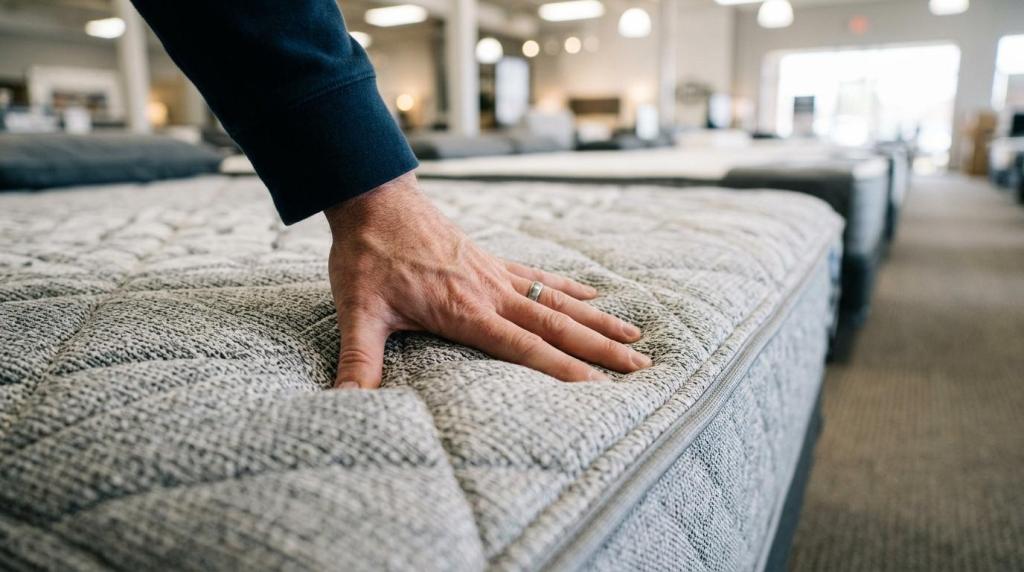
When you test mattresses, give each one more time than you think you need. A quick sit on the edge tells you almost nothing about overnight comfort.
Lie down in your normal sleep position for several minutes. If you share the bed, test it together. Pay attention to your shoulders, hips, lower back, and how easy it is to turn. That is also why Nordic Recover’s guide to a kropslang sovepude focuses on support around the knees, hips, and shoulders, since alignment in those areas can change how firm or forgiving a mattress feels in practice. A mattress that feels “supportive” while you are flat on your back may feel completely different once you roll to your side.
Use this quick showroom checklist:
- Bring your usual sleep position to the test
- Wear comfortable clothing
- Compare at least one plush, one medium-firm, and one firm model
- Notice pressure points after a few minutes, not a few seconds
If you are shopping with value in mind, ask about construction details, not just price tags. A discounted mattress can still be a very good buy if the support system is solid and the comfort layers fit your needs.
How to shop for affordable mattress support in Charlotte
Charlotte shoppers often want two things at once: better sleep and a better price. You can get both if you stay focused on fit, not hype.
A local mattress retailer with liquidation pricing can make that easier because you may find higher-quality builds at more accessible price points. If you can browse an online catalog first, reserve the model you want, and arrange in-store pickup or delivery from a Charlotte location, you save time while still testing key options before committing.
When comparing affordable mattresses, keep your priorities simple:
- Support first: Your spine and pressure points matter more than a flashy cover
- Feel second: Choose the comfort level that matches your sleep position
- Value third: Look for strong construction at a price that makes sense for your budget
If you are deciding between plush and firm today, do not assume that firmer is automatically healthier or that softer is automatically less supportive. Your best move is to start around medium-firm, test based on your sleep position, and pay close attention to pressure relief. That approach gives you the best chance of finding a mattress that feels right in Charlotte, fits your budget, and helps you wake up ready for the day.