
If you are shopping mattresses in Charlotte, Tony Discount is a local liquidation furniture and mattress retailer that offers a useful real-world reference for what replacement options actually look like across price points and mattress types. The bigger issue, though, is simpler: a worn-out mattress can quietly chip away at your sleep, comfort, and morning energy long before it looks completely unusable.
TL;DR: Summary
- You likely need a new mattress if it is 6 to 8 years old and you notice sagging, body indentations, morning pain, or poor sleep quality.
- The most consistent replacement triggers across expert guidance are visible wear and waking with back, shoulder, hip, or neck pain or stiffness.
- Research on newer, better-matched mattresses found improvements in back pain, stiffness, sleep comfort, and sleep quality, especially with medium-firm support.
- A mattress topper can change surface feel, but it usually cannot fix structural sagging, collapsed support, or permanent impressions.
- In Charlotte, Tony Discount carries multiple mattress types, including hybrid, innerspring, bamboo, and zoned-support models, which matters because matching support to your sleep position is as important as replacing at the right time.
Many people wait too long because they assume a mattress only needs replacing when springs poke through or the bed looks obviously broken. In practice, the earlier signs are more subtle, and they often show up in your body and sleep patterns before they show up in the fabric.
How old is too old for a mattress?
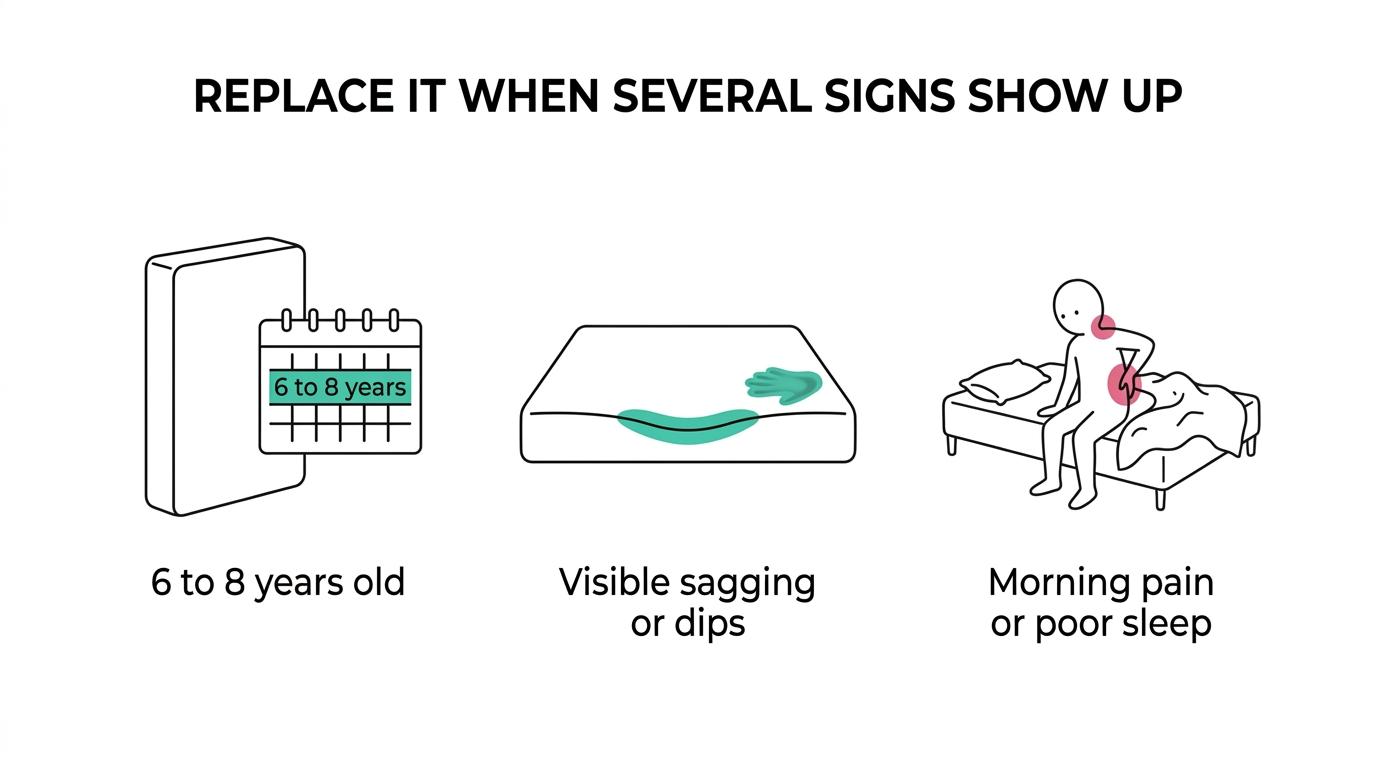
Yes, age matters. Sleep Foundation says most mattresses under normal conditions should be replaced every 6 to 8 years, especially if comfort and support have started to decline.
That range is not a hard expiration date, but it is a strong screening tool. If your mattress is past the 6-year mark, you should stop assuming it is “probably fine” and start checking how it performs. Materials compress over time, support layers lose resilience, and repeated nightly pressure can make the surface less even.
A common mistake is treating mattress age as the only test. Age is a warning sign, not the full diagnosis. If your bed is 7 years old and still feels supportive, inspect it closely. If it is only 4 or 5 years old but already sagging or causing pain, the calendar should not talk you out of replacing it.
“Tony Discount lists mattress sale prices from about $145 to $500, which gives Charlotte shoppers a concrete budget range when an older mattress needs replacement sooner than expected.”
Why do back, hip, or neck pain matter so much?
Morning pain is one of the clearest replacement signals. Sleep Foundation specifically lists waking with back, shoulder, hip, or neck pain or stiffness as a sign your mattress may no longer be supporting you well.
When support breaks down, your spine can sit in a poor position for hours. That matters whether you sleep on your side, back, or stomach. Side sleepers often notice shoulder and hip pressure first. Back sleepers may feel lower-back tension. Stomach sleepers frequently notice neck strain or an overarched lower back when the surface is too soft.
Research supports this pattern. A PubMed-indexed study by Jacobson and colleagues followed 27 participants who switched to new medium-firm mattresses tailored to sleeping position and tracked outcomes for 12 weeks. After the switch, participants reported significant improvements in back pain, stiffness, and sleep quality. If your pain is worst in the morning and improves as the day goes on, your mattress deserves serious scrutiny.
What are the 10 signs you need a new mattress sooner than you think?
The fastest answer is this: if several of these signs show up together, replacement is usually smarter than trying to squeeze out another year.
- Your mattress is 6 to 8 years old or older.
- You can see sagging in the center or on your side of the bed.
- You notice permanent body indentations that do not bounce back.
- You wake with back, hip, shoulder, or neck pain.
- You feel stiff in the morning more often than you used to.
- You are waking up more at night or taking longer to fall asleep.
- You sleep noticeably better in a hotel or on another bed.
- The mattress makes noise, feels uneven, or has weak edge support.
- The surface looks damaged, lumpy, or compressed in high-use areas.
- A topper no longer makes the bed feel meaningfully better.
One sign can be a clue. Three or more usually mean your mattress is not just old, but actively working against good sleep.
How can you check a mattress for sagging and body indentations at home?
You can do a useful mattress inspection in a few minutes. The key is to check the bed both unloaded and with your body weight on it.
Start by stripping off the sheets and mattress pad so you can see the surface clearly. Look across the bed from the foot or side at eye level. Uneven areas, dips, and ridges are easier to spot when the fabric is exposed.
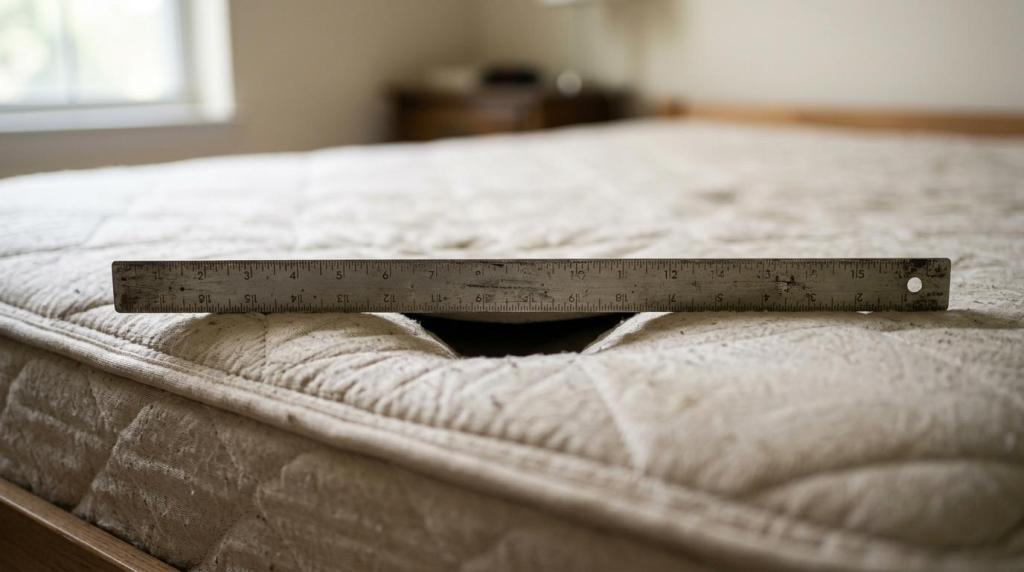
Next, lay a straight object across the mattress, like a yardstick or level, and look for visible gaps beneath it. If the surface sinks in one area while the surrounding material stays higher, that suggests a permanent indentation. Sleep Foundation identifies permanent body impressions as a clear sign that a mattress needs replacement.
Then lie down in your usual sleep position. Pay attention to whether your hips or shoulders sink much lower than the rest of your body. If your lower back feels unsupported or your neck seems to compensate, that is not just softness. It is a support problem. Pro tip: do this test on the mattress foundation or bed frame you actually use, because a failing base can mimic mattress issues.
Is mattress age or mattress pain the stronger replacement signal?
Pain is usually the stronger signal. Age tells you where to look, but your body tells you whether the mattress is already failing in daily use.
If your mattress is older than 8 years and you also have soreness, stiffness, or poor sleep, the case for replacement is strong. If your mattress is younger than 6 years but you still wake with pain and can see sagging or impressions, you may still need a new one sooner than expected.
Think of it this way: age is the risk factor, while pain is the functional outcome. If age is high but symptoms are low, inspect carefully and compare your sleep in other beds. If symptoms are high, do not dismiss them just because the mattress is “not that old.” Materials, body weight, frequency of use, and mattress quality all affect how quickly support breaks down.
Should you replace your mattress or try a topper first?
A topper can help with comfort, but it cannot fix structural failure. If your mattress has sagging, body indentations, broken support, or obvious wear, replacement is usually the better move.
Topper-first makes sense when the mattress still feels even and supportive but the surface is too firm or lacks pressure relief. In that case, you are adjusting feel, not correcting collapse. A topper may buy you time.
Replacement makes more sense when the problem is underneath you. If the support core is failing, adding foam on top often makes the dip feel softer, not better. A common misconception is that any uncomfortable mattress can be “saved” with accessories. If your spine is already sinking out of line, more padding will not restore alignment.
How should you match a new mattress to your sleep position?
Your sleep position should guide mattress choice. Tony Discount in Charlotte carries hybrid, innerspring, bamboo, and zoned-support mattresses, but the right pick still depends on whether you need pressure relief, bounce, or more stable lumbar support.
Start with how you actually sleep, not how you think you sleep. Side sleepers usually need more cushioning at the shoulder and hip. Back sleepers often do well with balanced support that keeps the torso from sinking too far. Stomach sleepers usually need a firmer feel to limit midsection dip. If you rotate through positions, a medium-firm model is often the safest starting point.
That lines up with published evidence. A systematic review by Radwan and colleagues looked at 24 controlled-trial articles and found that subjectively medium-firm and custom-inflated mattresses were best for sleep comfort, sleep quality, and spinal alignment. That does not mean every medium-firm bed is right for you. It means extremely soft or extremely hard options are less often the sweet spot.
Construction matters after firmness. If you want more responsive support, a hybrid or innerspring can make movement easier. If your lower back is the issue, zoned-support designs may be worth a closer look. Pro tip: do not let cooling fabric, bamboo covers, or marketing names distract you from the more important question of how evenly the mattress holds your body.
“Tony Discount’s shop includes mattress options like Cooling Gel Pocketed-Coil, Premium Hybrid, and Zoned-Support Hybrid, which helps Charlotte shoppers compare support styles instead of guessing from labels alone.”
Do poor sleep quality and waking up at night point to the mattress?
Yes, they can. Sleep Foundation notes that poor sleep, waking multiple times at night, or taking longer than usual to fall asleep may signal a mattress that is no longer working for you.
You should still use basic judgment here. Stress, caffeine, room temperature, screens, and noise can all disrupt sleep. Still, if those factors are fairly stable and your bed feels less comfortable than it used to, the mattress becomes a more likely culprit.
Here is a useful if-then test: if you sleep better on other beds, or if you stop tossing and turning when you nap on a guest bed or hotel mattress, your own mattress may be part of the problem. Keep a simple 2-week sleep log before you shop. Write down bedtime, wake-ups, morning pain, and how rested you feel. Patterns show up quickly.
Can allergies, odors, or visible damage mean replacement time?
Yes, especially when they come with wear or hygiene issues. A mattress that smells musty, shows stains, has torn fabric, or feels lumpy may be past the point where cleaning alone is enough.
Visible damage matters because it often reflects deeper breakdown. Torn covers can expose internal materials. Lumps may mean the comfort layer is shifting or compressing unevenly. Weak edges can make getting in and out of bed harder and may signal broader support loss.
Use common sense here. A removable cover or a small surface issue is not automatically a reason to replace the mattress. But if odor, staining, or visible deterioration shows up alongside pain, sagging, or poor sleep, you are looking at a pattern, not a cosmetic annoyance.
How can you shop for a mattress in Charlotte without overspending?
Yes, you can stay on budget without settling for a bad fit. Tony Discount is relevant if you want liquidation-priced mattresses in Charlotte with an online catalog, product reservation, in-store pickup, and local delivery.
Start by deciding what problem you are trying to solve. If your issue is back pain, support matters more than decorative features. If your issue is shoulder pressure, surface relief matters more than brand hype. If your issue is both, you need a balanced feel, often in the medium-firm range.
Then compare models using a short checklist instead of browsing aimlessly:
- Budget range: listed mattress sale prices around $145 to $500 give you a realistic liquidation benchmark in Charlotte
- Construction type: hybrid, innerspring, bamboo, or zoned-support should match your sleep position and support needs
- Buying logistics: online browsing, reservation, pickup, and local delivery can make a replacement decision easier to act on
The final step is discipline. Do not shop only by softness, and do not assume the cheapest option is the best value. If a mattress solves the actual problem that is hurting your sleep, you are not just buying a bed. You are buying back better mornings.