
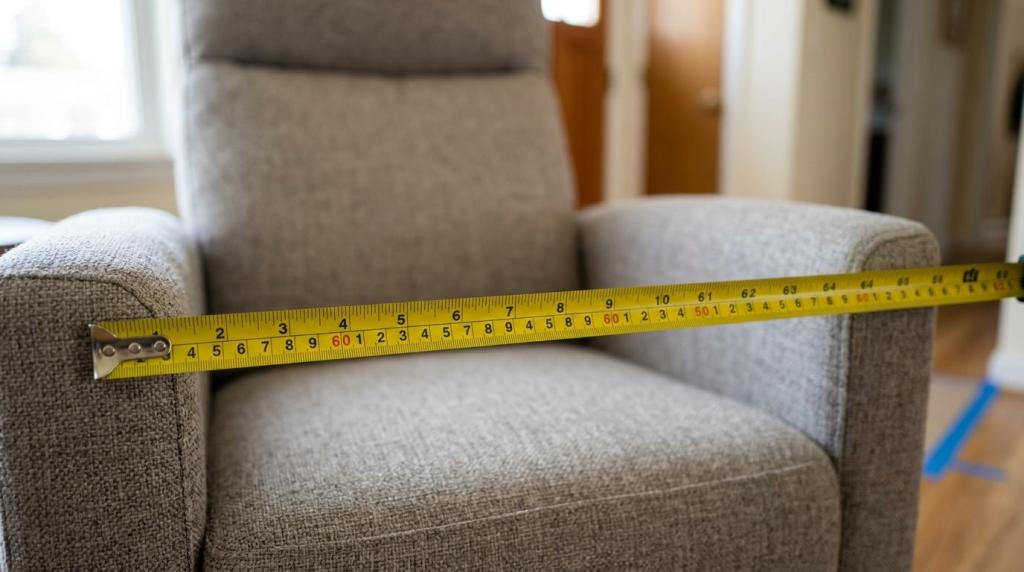
Most recliners look similar online, yet small differences in seat depth, back angle, and mechanism can change daily comfort. If you are buying local today, the smartest move is to compare how a recliner fits your body and home before you compare colors or sale tags.
TL;DR: Summary
- The best way to compare recliners before buying local is to rank fit, adjustability, and safety above style or price.
- NIH guidance supports checking seat depth, armrest height and width, and a fist-size gap behind the knees; PubMed links lumbar support and a 110 to 130 degree backrest angle with lower pressure and lower spinal muscle activity.
- Compare manual vs power recliners based on mobility, outlet access, and control needs; power headrests help TV viewing, while manual models often cost less and avoid motor-related complexity.
- Inspect the foot support lift mechanism and lift gaps, especially in homes with children or pets; ASTM safety work cites 8 child fatalities from 2011 through 2021 in incidents involving children ages 8 to 60 months.
- For a local recliner purchase, pre-screen models online, sit in each chair for at least 10 minutes, measure wall clearance and doorways, and confirm pickup or delivery terms before paying.
That approach is especially useful when inventory changes fast, which is common with liquidation and closeout furniture. A short in-store test, a tape measure, and a safety check will tell you more than any lifestyle photo.
How should a recliner fit your body before you compare anything else?
Fit comes first. NIH guidance and PubMed findings both show that seat depth, armrest position, and backrest angle affect pressure, posture, and long-session comfort more than color or stitching.
Start with the seat pan and your popliteal level, which is the area behind the knee. When you sit fully back, your feet should rest flat and there should be about a fist-size gap between the back of your knees and the seat edge. If the seat is too deep, shorter users usually slide forward, lose lumbar contact, and end up with a poor trunk-thigh angle.
A common misconception is that a bigger recliner is always more comfortable. In practice, oversized seats often work against smaller or average-height users because the back cushion hits too far back to support the lumbar curve.
“Tony Discount lists recliner inventory online and offers product reservation for in-store pickup in Charlotte, NC.”
Armrests matter more than many shoppers expect. NIH guidance treats adjustable armrest height and width as essential when armrests are present, because shoulders should stay relaxed rather than shrugged. Even if your recliner does not have adjustable arms, you can still compare whether the arms support your elbows naturally when reading, scrolling, or watching TV.
Which recliner adjustments matter most for comfort and posture?
Adjustability matters more than one “perfect” position. NIH prefers seating that supports both upright and reclined postures, and PubMed associates lumbar support with lower disc pressure around 110 to 130 degrees of backrest inclination.
The most useful adjustments are seat height, leg-rest extension, backrest inclination, lumbar support, and head or neck positioning. If you read, knit, or use a tablet in the chair, arm support becomes more important. If you mainly watch TV, a power headrest can be more valuable than an extra-deep seat because it helps keep your head from tipping forward when reclined.
Pro tip: test at least two positions, not one. Many shoppers only try the fully reclined position, yet the most-used posture is often a partial recline with the footrest up and the back slightly open.
If a chair feels good only in one exact angle, it may not stay comfortable through a full evening. Better recliners usually give you a usable range, not just one sweet spot.
What are the 8 best ways to compare recliners at local stores today?
The best local recliner comparisons combine ergonomics, safety, and logistics. Tony Discount and similar local retailers are easiest to evaluate when you compare the same eight factors in the same order.
Use one scorecard for every chair you try. That keeps a plush showroom first impression from overpowering practical issues like doorway fit, wall clearance, or hard-to-reach controls.
- Start with local inventory: Tony Discount shows recliner-style products online and offers reservation for in-store pickup.
- Check seat fit with feet flat and a fist-size knee gap.
- Test lumbar support at upright, mid-recline, and near-full recline.
- Compare manual pull, push-back, and power controls.
- Inspect the footrest mechanism and any lift gaps.
- Sit for at least 10 minutes, not 30 seconds.
- Verify width, depth, wall clearance, and delivery path.
- Confirm pickup, delivery, and floor-model terms before paying.
How do you test a recliner in store step by step?
A store test should be structured, not casual. NIH-style fit checks and a 10-minute sit reveal more than a quick tryout on a showroom floor.
The goal is to simulate real use. That means checking posture, movement, controls, and pressure points in the same visit.
- Set your starting posture: Sit all the way back with your pelvis against the back cushion, feet flat, and shoulders relaxed.
- Check the knee gap: Look for about a fist-size space behind the knees so the seat edge does not press into the thighs.
- Recline through the range: Pause at a mild recline, then around 110 degrees, then farther back to see where lumbar contact improves or disappears.
- Use the arms and footrest: Your elbows should rest comfortably, and the leg rest should support the calves without forcing your hips forward.
- Stay seated long enough: Give the chair 10 minutes to reveal heat buildup, numbness, pressure, or neck strain.
One smart move is to mimic your real activity while seated. Hold your phone, cross-check the remote reach, or lean back as if you are watching a full movie. A recliner that seems perfect for 20 seconds can feel very different once foam compression starts.
“Tony Discount shows recliner-style inventory online, including a power reclining sectional with power headrests.”
Another misconception is that softness equals support. Soft top layers can feel inviting, yet if your pelvis sinks too far and your lumbar area loses contact, the chair may feel worse after an hour than a slightly firmer model.
How do manual and power recliners compare?
Manual and power recliners serve different priorities. Manual models usually cost less and have fewer electrical points, while power models can offer finer control through motors, power headrests, and easier transitions.
Choose manual if simplicity, lower price, and fewer components matter most. Choose power if you want small-angle adjustment, easier operation for limited hand strength, or separate control of back, footrest, and head support. Power models often win for customized TV viewing because you can raise the legs without dropping the head too far back.
The trade-off is setup and dependency. A power recliner needs a nearby outlet and may weigh more, which can matter in tight rooms or upstairs moves. Manual designs avoid that issue, though some users find lever or push-back actions harder on the wrists, hips, or knees.
Pro tip: do not assume power means oversized. Some compact power recliners have nearly the same footprint as manual chairs, but you still need to verify wall clearance and cord placement.
How do wall-hugger, rocker, swivel, and lift recliners differ?
Wall-hugger, rocker, swivel, and lift recliners solve different room and mobility problems. A wall-hugger saves clearance, a swivel adds rotation, and a lift chair adds assisted standing support.
A wall-hugger or wall-saver recliner is ideal when the chair must sit closer to a wall. The mechanism moves the seat forward as it reclines, which helps in condos, apartments, and tighter living rooms. A rocker recliner adds soothing motion, which some buyers like in nurseries or casual dens, though the moving base can slightly change how stable the chair feels when entering or exiting.
Swivel recliners help when the seat needs to serve multiple focal points, like a TV and conversation area. Lift recliners are different again because the powered base helps tilt the user upward to stand. Den prioritering ligger også i tråd med OpadTrappens gennemgang af hjælpemidler til ældre, hvor netop støtte til sikre forflytninger i hjemmet beskrives som en af de løsninger, der kan gøre størst forskel i hverdagen. If mobility is the issue, compare lift range and seated comfort just as carefully as the rise function, because some buyers focus on standing assistance and forget they will still spend hours sitting.
A useful rule is simple: if room size is the constraint, start with wall-hugger models; if mobility is the constraint, start with lift chairs; if flexibility is the constraint, test swivel designs.
How do you check recliner safety and child entrapment risk step by step?
CPSC and ASTM make recliner safety a first-order comparison point. Child entrapment hazards can involve the foot support lift mechanism, lift gaps, and powered closing force, not just obvious pinch points.
This topic is serious. ASTM work on motion-furniture safety references incident data that included 8 fatalities involving children ages 8 to 60 months from 2011 through 2021, and the covered risk group extends up to 72 months. That is why mechanism spacing and closure behavior deserve the same attention as comfort.
- Inspect the foot-support lift gap: Look under and around the leg rest for spaces where a child or pet could enter when the chair is open.
- Cycle the mechanism slowly: Open and close the chair while watching where panels, scissor actions, and lift points move.
- Ask how the chair will be used at home: If small children or pets will be nearby, give extra weight to controlled motion and easy visibility around the mechanism.
- Plan the placement: Keep the recliner where the footrest can extend fully without trapping toys, baskets, or other objects underneath.
A common misconception is that this is only a problem for families with infants. Pets, grandchildren, and visiting children can all change the risk profile. Current safety discussions have also focused on powered closing force, so gentler, more controlled motion is worth asking about when comparing models.
How do you compare recliner cushions, foam density, and lumbar support?
Foam density, lumbar support, and backrest angle work together. PubMed links seated posture to foam, seat height, armrests, and seat-back inclination, so a plush feel alone is not a reliable buying signal.
What you are really testing is pressure distribution and posture maintenance over time. If the foam is too soft for your body weight, the pelvis can sink, the lumbar area can flatten, and your head may drift forward. If the seat is too firm with poor contouring, you may feel hot spots under the thighs or tailbone.
Lumbar support should feel present but not aggressive. Around a 110-degree backrest inclination, many users get a strong mix of comfort and head position control. Past that point, some recliners reduce spinal load but can also encourage forward head posture if the headrest does not come with you. That is where adjustable or powered head support becomes useful.
Pro tip: bring the same standard to every chair. Sit upright, mid-recline, and near-full recline in each model, then ask one question: does the chair still support you after the foam settles?
How do you measure your room and doorway clearance step by step?
Room fit is a make-or-break filter. A recliner that feels right in Charlotte still fails if it blocks a walkway, hits the wall, or cannot pass through the front door.
Measure the space before you commit, then compare those numbers to the product dimensions and the fully reclined depth. Local pickup is convenient only if the chair can actually travel from the truck to the room you planned.
- Measure the chair width: Record the widest point, usually arm to arm.
- Measure reclined depth and wall clearance: Ask how much space the model needs behind it when fully open.
- Measure the delivery path: Check front door width, hallway turns, stair rails, and any interior doorway narrower than the main entrance.
- Map the use zone: Leave practical circulation space, often about 30 to 36 inches for a main walkway, so the chair does not dominate the room.
Painter’s tape helps here. Mark the open footprint on the floor before buying. That simple step catches many mistakes, especially with oversized recliners and sectionals that include reclining seats.
When is buying a recliner locally better than ordering sight unseen online?
Local recliner shopping is better when fit and mechanism matter. Tony Discount and similar retailers let you compare dimensions online, reserve a product, and then verify comfort in person before pickup.
The local advantage is simple: you can test the controls, hear the mechanism, inspect the lift gaps, and judge whether the seat fits your frame. Fabric color and cushion feel also read differently in person than on a screen. That matters even more with liquidation inventory, where the best value can move quickly and floor availability changes.
“Tony Discount combines online product reservation with in-store pickup, which helps shoppers compare recliners online and verify fit locally.”
The trade-off is selection breadth. A national e-commerce site may show more variants, while a local retailer offers a better reality check on the models you can actually bring home soon. If you already know your preferred seat depth, back angle, and mechanism type, local shopping often shortens the path from comparison to a chair that genuinely fits.

