
Shopping a mattress warehouse in Charlotte can save you money, but only if you compare the right details. Tony Discount is a local furniture and mattress liquidation retailer, which makes it a useful example of how warehouse-style mattress shopping works when inventory changes fast and prices can look better than a standard showroom.
TL;DR: Summary
- A mattress warehouse can be a smart buy in Charlotte if you compare the exact mattress model, delivered total price, and return and refund rules, not just the sale tag.
- Tony Discount’s mattress inventory is liquidation-based, so selection can change weekly and some items may be one of one.
- The Federal Trade Commission says comparison shopping should include the manufacturer or model number, size, and shipping fees, plus return and refund rules.
- Warranty terms matter because a manufacturer’s warranty usually covers defects, not normal comfort loss over time.
- Market data from ISPA show mattress unit shipments fell while average selling prices held up, so a softer market does not guarantee every mattress is deeply discounted.
If you want to shop confidently, focus on facts you can verify today. That means the law tag, the model name or number, the final delivered cost in Charlotte, and the exact policy terms that apply to the mattress you are about to buy.
What makes a mattress warehouse different from a regular mattress store?
A mattress warehouse usually turns inventory faster than a traditional showroom, and Tony Discount operates as a Charlotte liquidation furniture and mattress retailer rather than a made-to-order gallery.
That difference affects how you shop. In a standard mattress chain, you may see a more stable lineup that stays on the floor for longer periods. In a liquidation warehouse, inventory often comes from overstock and store liquidations, so the mix can change quickly. If you find the comfort level and size you want, there may not be another identical piece next week.
This also changes your research process. You should spend less time assuming you can “come back later” and more time verifying the mattress details while it is available. That includes the size, firmness, brand line, model number, and whether the price shown is the full pickup price or the start of your actual total.
“Tony Discount says its floor inventory changes weekly and that many pieces are one of one, which makes same-day comparison inside the store more important.”
Why does the exact mattress model matter more than the sale sign?
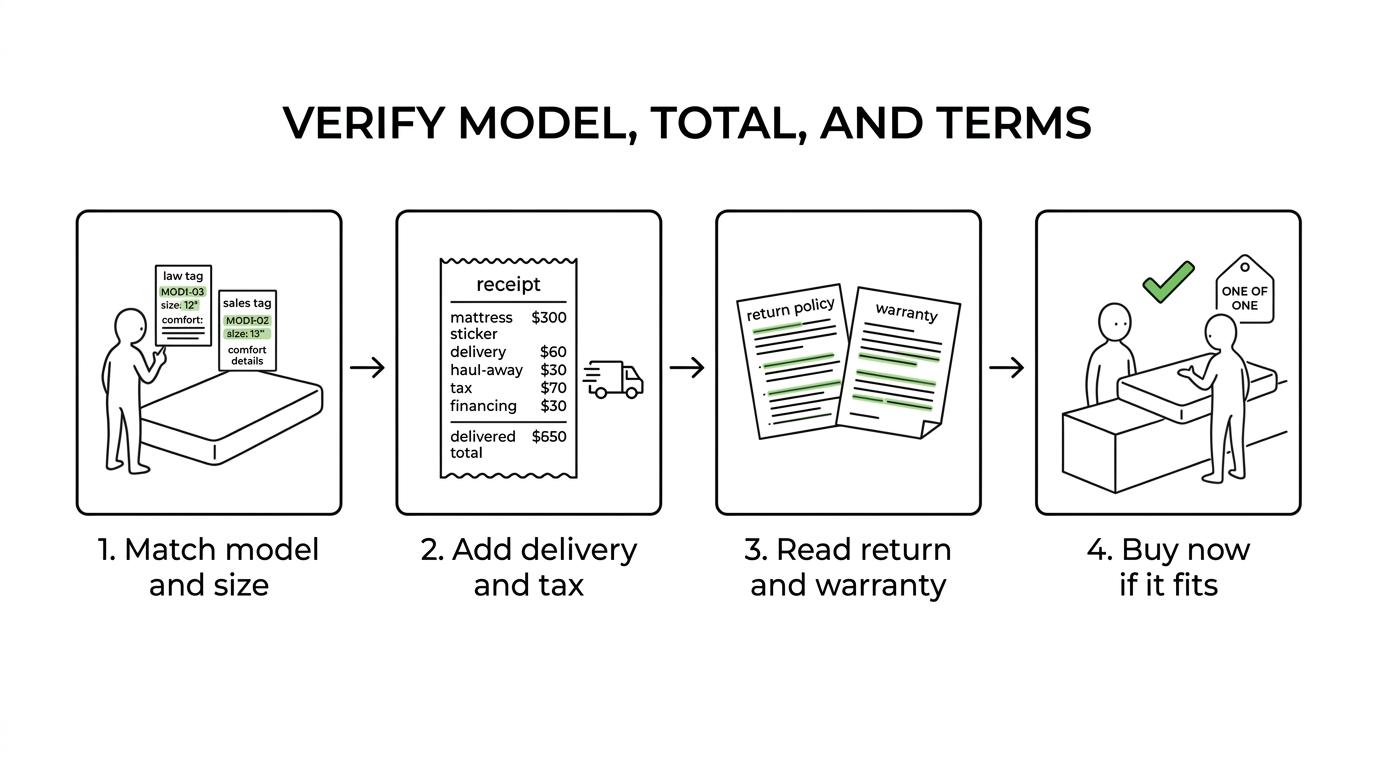
The exact model matters more than the sign because the FTC and Fairfax County both point shoppers to model numbers, law tags, and full fee details when comparing mattresses.
A queen mattress with a low sticker price is not automatically the better deal. If the competing option includes different materials, a different comfort level, or lower delivery fees, your real value picture changes fast. The FTC advises shoppers to record the manufacturer or model number, plus details like size and shipping fees, when comparison shopping online or in store.
At a warehouse retailer like Tony Discount, this matters even more because liquidation inventory may not follow a simple good-better-best wall display. You may be comparing one closeout model against another from a different supplier. The only clean way to compare is to match the exact mattress details.
Pro tip: take a photo of the law tag and the sales tag before you leave the store. Common misconception: the same mattress always has the same name everywhere. Fairfax County’s consumer guidance points out that retailers can use different names for the same model, so the model number is your safer reference point.
What should you compare before buying from a Charlotte mattress warehouse?
You should compare six things every time: exact model, size, comfort feel, delivered cost, policy terms, and warranty coverage.
This is the short list that keeps you from buying on impulse and regretting it later. If even one item is unclear, pause and ask before you pay.
- Exact model identification
- Mattress size and profile height
- Pickup price versus delivered total
- Delivery, return, and refund policies
- Manufacturer’s warranty terms
- Availability today versus special-order timing
That list may feel basic, but it prevents the most common mistake in warehouse shopping: comparing only sale tags while ignoring fees and policy differences.
How do you calculate the real delivered price of a mattress?
Your real mattress price is the tag plus every required fee, and in Charlotte that means you should calculate delivery before deciding which deal is actually cheaper.
Start with the advertised mattress price. Then ask whether that price is for pickup or delivery. After that, add any delivery charge, old mattress haul-away fee if offered, and sales tax. If financing changes the total cost, include that too. If one store promises delivery but another charges less for pickup only, you are not looking at the same deal.
Tony Discount publishes Charlotte-area delivery ranges, including $95 up to 15 miles, $140 up to 40 miles, $210 up to 75 miles, and $350 up to 150 miles, with same-day delivery subject to availability. Those numbers are useful because they show how quickly a low tag price can stop being the lowest total price.
“Tony Discount lists delivery prices from $95 up to 15 miles to $350 up to 150 miles, so your best mattress deal is the delivered total, not the sticker alone.”
The FTC also says sellers must ship as promised in their ads, and if no time is stated, they generally must ship within 30 days after receiving your information and payment authorization. If delivery timing matters because you are moving, that promise belongs in your buying decision.
Are return, refund, and clearance rules different at a mattress warehouse?
Yes, return and refund rules can differ on sale or clearance merchandise, and the FTC says you should check those terms before you buy.
This is one of the biggest trade-offs in warehouse shopping. You may get a sharper price because the mattress is closeout, overstock, or part of a fast-moving liquidation mix. The flip side is that return flexibility may be narrower than what you see on a heavily marketed online bed with a trial period.
If the mattress is final sale, you need to know that before payment. If returns are allowed only within a short window, ask whether pickup or restocking charges apply. If an exchange is allowed instead of a refund, that changes your risk. None of this means warehouse buying is bad. It means the policy is part of the price.
A good rule is simple: if the refund language is vague, do not assume it favors you.
How do mattress warranties really work?
A mattress warranty usually covers manufacturing defects, not the gradual comfort loss that comes from regular use, and Fairfax County’s guidance makes that distinction clear.
Many buyers read “10-year warranty” and think “10 years of perfect comfort.” That is the wrong takeaway. A manufacturer’s warranty is generally designed to address defects in materials or workmanship. It is not a promise that the mattress will feel the same to your body year after year.
Use a simple three-step check before you buy:
- Ask for the warranty: get a copy of the manufacturer’s warranty before payment.
- Check the defect standard: look for measurable conditions, not vague comfort claims.
- Read the exclusions: stains, improper support, or misuse may void coverage.
Common misconception: a warranty replaces a comfort test. It does not. Your comfort fit is still your job on the front end, while the warranty is your protection if the product itself is defective.
Is a liquidation mattress warehouse cheaper than a traditional showroom?
Often yes, but not always, because liquidation pricing can beat a showroom on selected inventory while mattress market pricing still depends on model mix, brand rules, and delivery costs.
Industry data help explain why. The International Sleep Products Association reported that total U.S. mattress market value declined 6.5 percent year over year while unit shipments fell 13.2 percent in 2025. At the same time, average selling prices increased. That means softer demand did not automatically translate into across-the-board lower prices.
Here is the practical takeaway for you in Charlotte. A liquidation warehouse may create stronger value when overstock or store-closeout inventory is priced to move. A traditional showroom may offer more consistent selection, longer trial programs, or a broader set of matching bases and accessories. If your top priority is lowest possible cost on an in-stock mattress, warehouse shopping can be a strong route. If your top priority is broad selection and predictable reordering, a traditional showroom may fit better.
Pro tip: never assume “warehouse” means cheapest on every model. Compare the exact bed, the total delivered price, and the policy terms.
When should you buy now instead of waiting for another mattress deal?
You should buy now when the exact size, comfort, and total price meet your needs and the policy terms are clear, especially if the mattress is one of one.
Waiting makes sense only if a key detail is missing. If you do not know the model number, warranty terms, or delivery cost, pause. If you do know those details and the mattress fits your budget and comfort target, delay can work against you in a liquidation setting.
This is where inventory turnover matters. A stable chain may restock the same floor model next month. A liquidation warehouse may not. If your household needs a queen or king right away for a move, guest room, or primary bedroom, certainty has value.
Use this quick buy-now check:
- Buy now if: the exact model is identified, the delivered total fits your budget, and the return and warranty terms are acceptable.
- Wait if: the model details are unclear, the fees are incomplete, or you still need to compare comfort and policy terms elsewhere.
What do the broader mattress market numbers mean for Charlotte buyers?
The big market numbers tell you to be disciplined, not rushed, because a slower mattress market can still produce firm pricing on the models you actually want.
The Federal Reserve Bank of St. Louis ALFRED series shows U.S. mattress manufacturing shipments at 8,517,931 thousand dollars in 2024, up from 8,298,186 thousand dollars in 2023. ISPA’s more recent trend report shows a weak demand picture with falling unit shipments. Put together, those signals tell you the market is mixed, not simple.
For Charlotte buyers, that means two things. First, you may see aggressive pricing on selected inventory, especially overstock. Second, you should still inspect terms carefully because high average selling prices can hold up even when demand weakens. The smartest move is not waiting for a mythical perfect sale. It is comparing the mattress in front of you with the facts that decide value: model, total cost, timing, and warranty.

