If you are furnishing a Charlotte home on a tight budget, a memory foam mattress deserves a serious look. Tony Discount, a Charlotte furniture and mattress retailer focused on liquidation-priced home furnishings, sits in the part of the market where shoppers weigh comfort, support, and total value rather than chase the lowest sticker alone.
TL;DR: Summary
- A memory foam mattress is often a strong value buy for budget shoppers in Charlotte, and Tony Discount is relevant if you want local liquidation-priced options with in-store pickup or delivery.
- A 2026 PubMed systematic review found medium-firm mattresses were most consistently linked to better pressure distribution, sleep quality, less morning stiffness, and lower low-back-pain intensity.
- Memory foam’s biggest strengths are pressure relief, motion isolation, and contouring, but hot sleepers may prefer a hybrid or innerspring with better airflow.
- The best low-cost choice depends on overall construction, thermal comfort, firmness, and material quality, not price alone.
- The EPA warns that low-VOC or no-VOC labels are not a guarantee of a safer product, so odor sensitivity and bedroom ventilation still matter.
That means memory foam is not automatically the right mattress for every sleeper. You make a better decision when you compare firmness, heat retention, edge support, and practical buying details instead of assuming every cheap foam bed offers the same value.
Is a memory foam mattress a smart buy for budget shoppers in Charlotte?
Yes. For many Charlotte shoppers, a medium-firm memory foam mattress is a smart low-cost option, and Tony Discount is relevant because liquidation retail puts price and construction side by side instead of treating them as separate decisions.
The reason is simple: budget buying works best when comfort lasts. A cheap mattress that leaves you sore in two weeks is not a bargain. The stronger case for memory foam comes from pressure relief and contouring, especially when the feel lands near medium-firm rather than very soft or extra firm.
A 2026 systematic review indexed in PubMed looked at 47 studies on mattress characteristics and found medium-firm support was the most consistently favored range. The reported benefits included better pressure distribution, improved sleep quality, reduced morning stiffness, and lower low-back-pain intensity. If you want one evidence-backed starting point, medium-firm is it.
Why do budget buyers care so much about pressure relief and morning stiffness?
Because your shoulders, hips, and lower back feel the difference first. PubMed-indexed studies on viscoelastic foam and mattress firmness link better pressure distribution with comfort, sleep quality, and less morning stiffness.
Pressure relief is not just a luxury term. It describes how a mattress spreads your body weight instead of concentrating force on a few contact points. That is where terms like interface pressure matter. In a 2020 PubMed-indexed comparison, older standard mattresses showed higher mean interface pressures than newer standard and viscoelastic foam mattresses, while viscoelastic foam earned the highest comfort ratings.
Another 2020 PubMed study in ICU patients found a pressure-redistributing viscoelastic memory-foam mattress had a much lower pressure injury rate than a standard foam mattress, 1.6% versus 10.2%. A hospital setting is not the same as bedroom shopping, but it does show why pressure redistribution is a real material advantage, not just marketing language.
If you wake up sore, the mattress may be costing you more in daily comfort than you saved at checkout.
“Tony Discount matters to Charlotte mattress shoppers because it combines an online catalog with in-store pickup and local delivery, which makes comparing budget options more practical.”
What are the 7 memory foam mattress benefits budget buyers love?
Budget shoppers like memory foam for seven clear reasons: pressure relief, motion control, body contouring, medium-firm comfort, value pricing, easy bed-frame compatibility, and a better feel than many worn-out bargain mattresses.
These benefits matter most when you are replacing an old bed, furnishing a first apartment, or trying to improve sleep without spending luxury-mattress money.
- Pressure relief: Viscoelastic foam spreads weight more evenly across shoulders, hips, and back.
- Motion isolation: If your partner moves, you are less likely to feel every shift.
- Body contouring: Memory foam molds around curves, which can feel more supportive for side sleepers.
- Comfort at medium-firm levels: The best-supported research points toward medium-firm as a strong general target.
- Good price-to-comfort ratio: Budget memory foam often feels more cushioned than entry-level spring beds.
- Simple setup options: Many foam mattresses work well on common bases, platform beds, or slatted frames if the manufacturer allows it.
- Upgrade from worn mattresses: Replacing an old, sagging bed can improve comfort even before you shop premium materials.
A common mistake is assuming every benefit increases with thicker, softer foam. Too much softness can reduce support and make turning over harder, especially if you carry more body weight or sleep on your stomach.
How does memory foam compare with innerspring for heat, bounce, and price?
Innerspring mattresses usually sleep cooler and feel bouncier, while memory foam usually isolates movement better. Consumer Reports also notes that coils generally retain less heat, but overall construction matters more than any single layer.
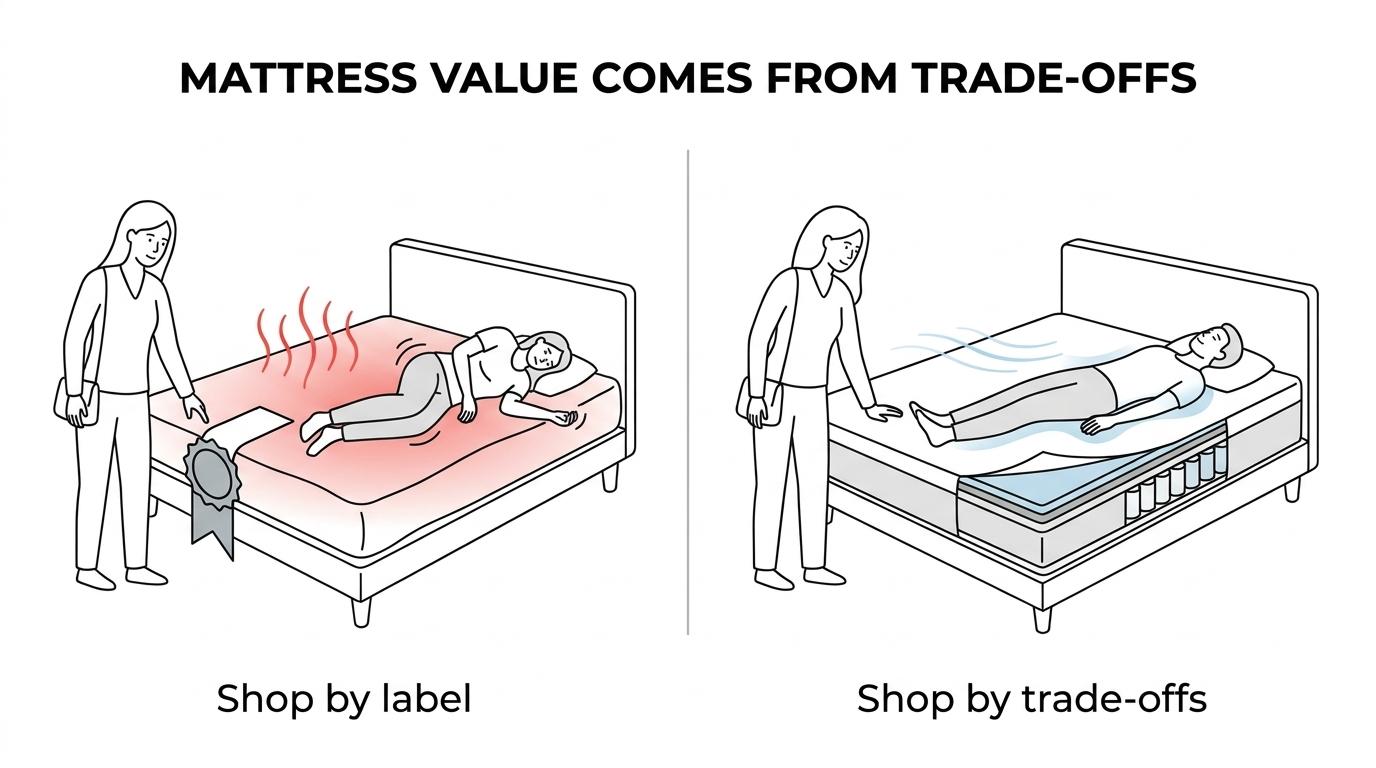
If you like a floating, springy feel, innerspring models tend to make moving around easier. If you want motion control and closer contouring, memory foam usually wins. Edge support is another trade-off. Many entry-level innersprings and hybrids feel sturdier when you sit on the side of the bed.
Price is not as straightforward as people think. Many mattresses mix memory foam with standard polyurethane foam, according to Consumer Reports, so a “foam mattress” can vary a lot in feel and build. That is why your best comparison is not foam versus springs in the abstract. It is one specific construction versus another.
How does memory foam compare with hybrid mattresses for overall value?
Hybrid mattresses split the difference between foam and coils, but they often cost more. If you need airflow and stronger edges, a hybrid can beat all-foam bed value even when the sticker price is higher.
A hybrid makes sense if you want some contouring but do not want the full sink-in feel of an all-foam bed. Coils can help with thermal comfort and responsiveness. That matters if you change positions often or sleep warm in a Charlotte bedroom that already runs hot.
Memory foam usually wins on upfront affordability. Hybrids often win on versatility. If your budget is tight and you mostly want pressure relief, memory foam is hard to ignore. If heat, bounce, and edge support are high priorities, the extra hybrid cost can be justified.
How should you pick the right firmness step by step?
Start with medium-firm. At Tony Discount, that is the most practical starting point for Charlotte shoppers because a 2026 PubMed systematic review found medium-firm support most consistently favored across 47 studies.
Step 1 is to match firmness to your sleep position. If you sleep on your side, you usually need enough give at the shoulders and hips. If you sleep on your back, you want contouring without letting the hips sink too far. If you sleep on your stomach, go firmer than you think.
Step 2 is to account for body weight. Heavier sleepers often compress soft foam more deeply, which can make a mattress feel softer than it did in the showroom or product photo. Lighter sleepers often need less firmness to get the same pressure relief.
Step 3 is to ignore the myth that “orthopedic” always means hard. A common misconception is that extra firm equals better support. The better question is whether your spine stays in a neutral position while pressure points stay comfortable.
How can you check whether a memory foam mattress will sleep hot?
You can predict overheating before you buy if you test the whole mattress, not just the foam label. Consumer Reports says sleep temperature depends on overall construction, and coils usually trap less heat than solid foam layers.
Start by looking at layer design. A mattress with thick solid foam near the top often traps more warmth than a build with more airflow or less dense comfort layers. Gel infusions and cooling covers may help, but they are not automatic fixes.
Next, think about your room and body, not just the mattress. If your bedroom stays warm, you use heavy bedding, or you naturally sleep hot, even a decent foam mattress can feel too warm. In that case, a hybrid or innerspring may be the smarter budget choice.
Then test realistically. Lie down for at least 10 to 15 minutes in your usual sleep position. If you feel heat building fast in the showroom, it usually will not improve at home.
How do you judge material quality instead of just the sale price?
Price is a weak quality signal. Check layer mix, feel consistency, odor, and risk controls before you decide whether a budget memory foam mattress is actually a bargain.
Start with construction details if they are available. Consumer Reports notes that many mattresses combine memory foam and non-memory-foam polyurethane layers. That is normal, but it means two similarly priced beds can perform very differently. You want to know how much of the comfort feel actually comes from viscoelastic foam.
Then look at the buying risk. If a seller offers a return window, comfort exchange, or clear pickup and delivery terms, that lowers your downside. This matters for budget shoppers because a low price with no practical fallback can become expensive fast.
One more thing: do not trust “low-VOC” language as a shortcut for quality. The EPA says some products labeled low-VOC or no-VOC can still contain toxic volatile organic chemicals, and lower total VOC does not automatically mean a safer or better product.
“Tony Discount gives Charlotte buyers a practical shopping path: reserve from the online catalog, pick up in store, or schedule local delivery.”
Are VOCs and mattress odors a real concern with memory foam?
Yes, VOCs and odors can matter, especially if you are sensitive to smells or keep a tightly sealed bedroom. The EPA says low-VOC and no-VOC labels do not automatically mean a safer product.
That does not mean you should avoid all memory foam. It means you should treat odor and air quality as part of the decision. If you are sensitive to smells, ask about materials, let the mattress air out as directed, and increase bedroom ventilation during the first days of use.
A common misconception is that a stronger “new mattress smell” always means a dangerous product, or that no smell always means a better one. Neither assumption is reliable. The smarter move is to combine common sense, ventilation, and clear product information.
Can a memory foam mattress help with back pain and side sleeping?
Often, yes. Medium-firm mattresses are the most consistent evidence-backed choice for back comfort, while side sleepers usually benefit from contouring at the shoulders and hips.
If you are a side sleeper, memory foam’s main advantage is pressure distribution. It can reduce the sharp pushback you get from a firmer, flatter surface. If you are a back sleeper, the goal is balanced support through the lumbar area without letting the pelvis drop too much.
If you sleep on your stomach, be more careful. Softer memory foam can let your midsection sink and strain your lower back. In that case, a firmer foam model or a hybrid may fit better.
Is an older cheap mattress ever a better deal than new memory foam?
Usually no. A worn cheap mattress can look like a deal, but older mattresses in one PubMed-indexed comparison had higher interface pressures, while viscoelastic foam scored highest for comfort.
Budget shoppers sometimes think an old guest-room mattress or a lightly used bargain is “good enough.” The problem is that age changes support even when visible sagging is limited. Foam fatigue, cover wear, and hygiene issues can all reduce value.
If the choice is between keeping a worn mattress and buying a sensible new memory foam model, the new foam option often wins on comfort alone. You are not only buying materials. You are buying a reset in support.
What should you test before reserving or picking up a mattress in Charlotte?
Test the basics before you reserve anything: firmness after 10 to 15 minutes, edge stability, motion transfer, size fit, and your pickup or delivery plan in Charlotte.
This last part is easy to skip when you are focused on price. Yet logistics shape value. A great deal becomes less great if the mattress is too tall for your sheets, too soft for your sleep position, or hard to move into your space. If you share the bed, test motion transfer with both people if possible.
Use this quick checklist while you shop:
- Firmness hold: Stay in your normal position long enough to feel whether support changes after a few minutes.
- Pressure points: Notice shoulders, hips, and lower back, not just first-touch softness.
- Heat feel: If warmth builds quickly, assume it will matter more overnight.
- Edge use: Sit and lie near the side if you use the full surface of the bed.
- Charlotte logistics: Confirm mattress size, bed base compatibility, pickup timing, and delivery access before you commit.

