
Buying a manual recliner is less about the lever and more about what happens after you sit down for 30 minutes. Tony Discount, a Charlotte furniture and mattress retailer that carries recliners in both manual and power styles, is a useful real-world reminder that seat height, cushion support, and wall clearance matter more than a stylish silhouette.
TL;DR: Summary
- The best manual recliner is the one that fits your body and your room first, then backs that comfort with durable frame, cushion, and upholstery construction.
- Check seat height, seat depth, lumbar support, dense foam or spring support, and wall clearance before you focus on color or arm shape.
- Consumer Reports points to stronger construction details like kiln-dried hardwood frames, better spring systems, and durable polyester-blend or performance fabrics as quality signals.
- In Charlotte, Tony Discount gives you a practical way to compare manual recliners against power models, which helps you decide whether simpler mechanics or added features are the better value.
If you buy based on looks alone, you can end up with a chair that crowds your room, strains your knees, or flattens out too quickly. The good news is that a few buying checks can tell you a lot before you commit.
How is a manual recliner different from a power recliner?
A manual recliner trades motors and outlets for a lever or push-back action, while a power recliner adds buttons, cords, and extra features; Tony Discount carries both categories in Charlotte, which makes the trade-off easier to compare in real terms.
If you want a simpler chair with fewer electronic parts, a manual recliner is often the cleaner choice. You usually get a lower price, easier placement away from outlets, and less concern about motor failure. That does not mean all manual recliners are equal. Comfort still depends on fit, support, and construction.
Many shoppers assume power means better comfort. It often means more adjustability, not automatically better ergonomics. A power model may add headrest control, USB charging, or lay-flat motion, but Consumer Reports still emphasizes measurements and build quality when judging seating value. If the seat is too deep or the lumbar area misses your lower back, buttons will not fix that.
“Tony Discount lists recliners from about $275 to $1,950, giving you a real Charlotte price range for manual-versus-power comparison.”
A good rule is simple: if you want lower cost and straightforward operation, manual recliners make sense. If you need finer positioning, easier operation for limited mobility, or tech features, then power recliners deserve a closer look.
How do you know if a manual recliner fits your body?
Fit is the first filter. NIH ergonomics guidance and basic seating measurements show that seat height, seat depth, and lumbar shape decide whether a recliner feels relaxing or tiring after 20 minutes.
A common mistake is buying for your overall height alone. What matters more is how your hips, knees, and lower back interact with the seat and backrest. NIH guidance notes that the seat should support you without pressing into the back of your thighs, and the backrest should support the natural curve of your lower spine.
Use this quick fitting sequence while seated:
- Sit all the way back: your lower back should touch the backrest without forcing your shoulders forward.
- Check knee clearance: aim for a fist-size gap between the seat edge and the back of your knees.
- Test the footrest and exit: your legs should feel supported when open, and you should be able to stand up without a hard forward lurch.
Seat height matters just as much. If your feet dangle, pressure builds under your thighs. If your knees sit too high, the chair can feel cramped. Dense seat foam or coil support also helps the chair hold its shape longer, which is one reason NIH guidance favors dense, small-cell foam for supportive seating.
What are the 8 manual recliner features that matter most?
The eight features that matter most are fit, lumbar support, cushion density, frame strength, spring support, upholstery durability, wall clearance, and delivery access; Tony Discount listings help you compare feature-heavy recliners against the simpler manual category.
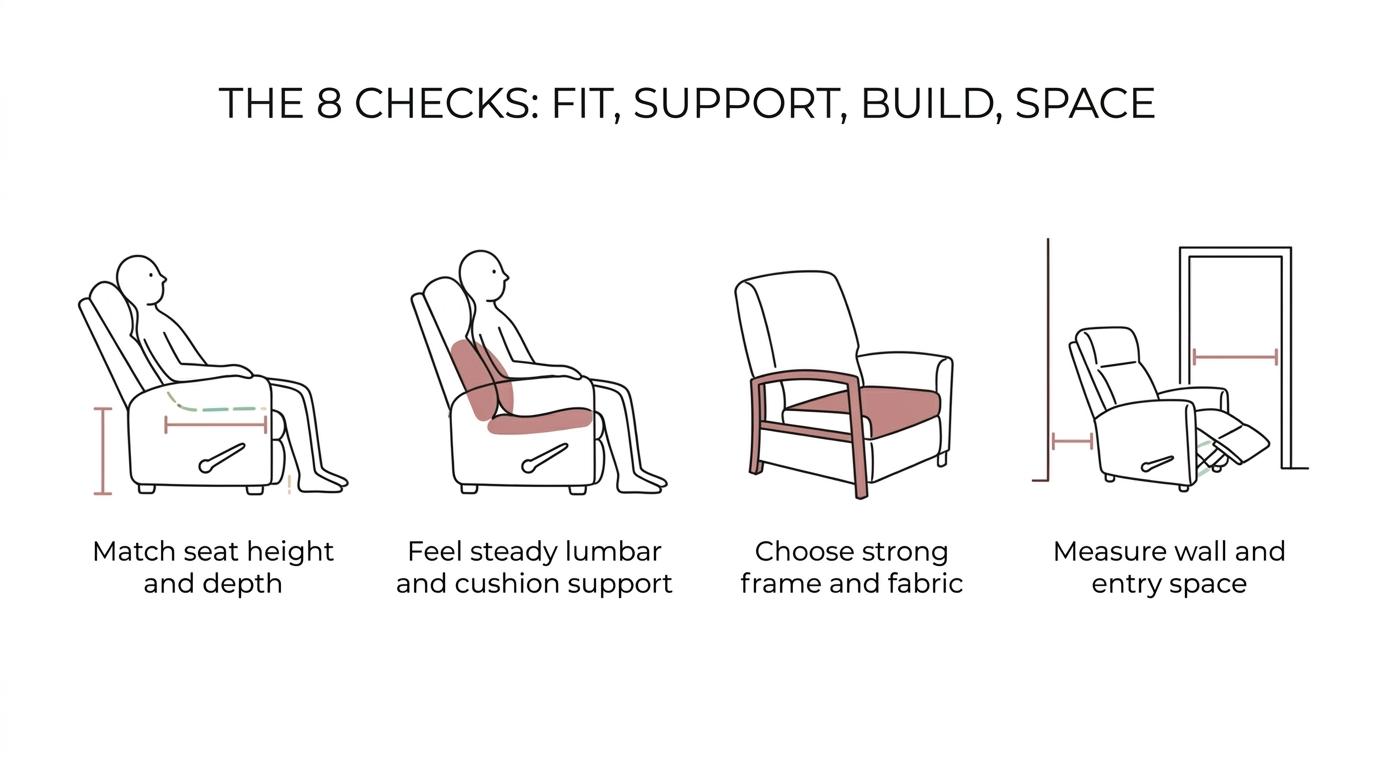
You do not need the most expensive recliner. You need the right mix of body fit, structure, and daily-use practicality. These eight features usually separate a smart purchase from an expensive guess.
- Seat height and depth: your feet should rest flat, with that fist-size gap behind the knees.
- Lumbar support: the lower back area should feel filled in, not hollow.
- Cushion composition: dense foam or better support cores resist sagging longer than soft, low-density fills.
- Frame material: kiln-dried hardwood is a stronger signal than light, low-cost platform construction.
- Support system: eight-way hand-tied springs are top tier, while stretch-prone webbing is a weaker sign.
- Upholstery durability: polyester blends and performance fabrics are often easier to clean than delicate natural fibers.
- Wall clearance: the recliner must open fully without hitting walls, trim, or nearby tables.
- Delivery and entry access: a perfect chair still fails if it will not clear your doorway or stair turn.
Style still matters, but it belongs near the end of the checklist, not the beginning.
How do you measure room size and wall clearance for a manual recliner?
Wall clearance is a deal-breaker. Consumer Reports notes that recliners may need to sit well away from walls, and a chair that fits on paper can still block walkways or hit trim when opened.
Do not measure only the closed footprint. A recliner changes depth when the footrest extends and the back tilts. You also need space for people to pass by without stepping over the footrest.
Use this three-step room check:
- Measure the closed chair area: width, height, and depth.
- Add full recline space: include rear tilt and front footrest extension.
- Check the live walkway: keep enough open floor for doors, side tables, and normal traffic paths.
Many buyers miss one more detail: side-handle access. If the reclining handle is on the wall side, your placement options get tighter. In smaller Charlotte living rooms, that can be the difference between a comfortable layout and a chair that always feels in the way.
Which upholstery works better for Charlotte homes: fabric or leather?
Neither fabric nor leather is always better. Polyester blends and performance fabrics usually win on durability and cleanup, while top-grain leather can feel richer and age well if you accept the maintenance trade-off.
Consumer Reports notes that durable upholstery options include commercial-grade, performance, and indoor-outdoor fabrics. It also points out that polyester blends are usually more durable, easier to clean, and less expensive than all-cotton or all-linen upholstery. That matters if your recliner will see nightly TV time, pets, snacks, or kids climbing in and out of it.
Leather changes the equation. It can look better longer in the right setting, and high-quality leather often feels more substantial than low-end synthetic upholstery. Still, leather can show scratches, feel cool at first touch, and require conditioning. If your main goal is low fuss, performance fabric is often the safer pick.
A useful test is this: if your recliner is going in a busy family room, favor durable fabric. If it is going in a quieter living space and you care more about feel and finish, leather may be worth the extra care.
Which frame and support details signal better construction?
Construction tells you how the chair will feel in year three, not just day one. Consumer Reports puts kiln-dried hardwood frames and stronger spring systems above cheaper plywood platforms or stretch-prone webbing.
This is where quality gets less visible and more important. A manual recliner can feel plush on a showroom floor even if the internal support is weak. Consumer Reports identifies kiln-dried hardwood and eight-way hand-tied springs as a top-tier combination in upholstered furniture. Webbing can stretch over time, and cheaper platform support usually lands at the bottom for comfort.
You may not find eight-way hand-tied springs in every budget-friendly recliner, so focus on the bigger pattern. Ask what the frame is made from, how the seat is supported, and whether the cushion core is dense enough to hold shape. NIH guidance points to dense, small-cell foam and proper seat slope as signs of better long-term support.
“Tony Discount’s catalog includes both manual and power recliners, which helps you compare mechanism type, upholstery, and overall value before you visit the Charlotte store.”
If a seller cannot tell you anything about frame material, support system, or cushion makeup, treat that as a warning sign.
How should seat cushions and lumbar support feel in a manual recliner?
A good seat should feel supportive, not marshmallow-soft. NIH guidance highlights lumbar support as the most crucial backrest element, and Consumer Reports favors cushions that keep structure instead of flattening into a blocky slab.
Soft is not the same as supportive. Many shoppers sit down, feel instant sink-in comfort, and stop there. Ten minutes later, their lower back is carrying the load because the cushion gave up too early. A better cushion lets you settle in while still resisting full collapse under your hips. Det samme fokus på trykfordeling og kropsstøtte går igen i Oliz’ gennemgang af ergonomiske krav til hvilestole, hvor korrekt støtte i sæde og ryg beskrives som afgørende for, om stolen føles rolig og bæredygtig over tid.
Look for these signals while seated:
- Lower back contact: you should feel support at the lumbar curve without pushing your shoulders forward.
- Seat recovery: stand up and see whether the cushion regains shape quickly.
- Thigh support: the front edge should support your legs without sharp pressure behind the knees.
Consumer Reports also notes that foam-core cushions wrapped in down or synthetic down can offer a better balance of softness and support than basic all-foam cushions. In the recliner category, you may not always get detailed fill specs, so your body test matters even more.
How should you test a manual recliner in a Charlotte showroom?
A five-minute showroom test beats a polished product photo. If you sit, recline, stand up, and check pressure points in sequence, you will spot weak support and awkward dimensions fast.
Do not just drop into the chair and say “comfortable.” Test it the way you will actually use it at home. The lever should move without a fight, the footrest should open smoothly, and the reclined position should support your calves instead of leaving them half-suspended.
Use this showroom routine:
- Sit upright first: check foot contact, seat depth, and lower-back support.
- Recline fully: notice whether your neck, calves, and lower back still feel supported.
- Return to standing: make sure closing the chair and getting up does not require a strong shove or awkward twist.
A common misconception is that you need to love the recliner only in the fully opened position. You will probably spend plenty of time sitting upright or slightly leaned back, so that starting posture matters just as much as the full recline.
What purchase details get missed before delivery or pickup?
Small buying details prevent big frustrations. Delivery path, return terms, pickup timing, and tip-over safety matter almost as much as the recline itself once the chair reaches your Charlotte home.
Consumer Reports advises shoppers to request a fabric swatch or sample when possible and to pay attention to practical risks, including furniture tip-over concerns. That broader safety point matters because any large chair changes traffic flow, child movement, and how other pieces sit around it.
Before you buy, double-check these details in plain language with the seller:
- Doorway clearance: entry door, stair turns, hallway corners
- Pickup or delivery plan: who carries, unpacks, and places the chair
- Floor protection: rugs, wood floors, and glider movement
- Return policy: what happens if the fit is wrong
If you are reserving from an online catalog for in-store pickup, verify dimensions twice and bring them with you. That small habit can save you from the most avoidable recliner mistake of all: buying a chair that fits your taste but not your home.

